Tuesday, January 10, 2012

F-111

F-111 Aardvark


General Dynamics


F-111 Aardvark


In 1960 the Air Force wanted a plane that could provide air superiority and be capable of both conventional and nuclear bombing missions.  This is at a time when missiles were believed to have made close air combat obsolete.  Thus we have the F-111 designation for this plane that never really performed the role of fighter.  As a cost saving move Secretary of Defense Robert McNamara decided the jet should replace the Navy's F-4 Phantom, despite Navy objections.  Eventually weight killed the idea of the F-111 being a carrier based plane and the Grumman F-14 Tomcat came into being.  


F-111F


Crew:                    2 - Pilot, Weapons Officer

Power:                  2 - Pratt & Whitney 11,395 kg / 25,100 lb afterburning thrust
                                   TF30-P-100 turbofans

Max. Speed:        2655 kph / 1650 mph
Ceiling:                17,995 m / 59,000 ft
Range:                 4707 km / 2925 miles
Climb:                  6710 m / 22,000 ft per minute

Weight -
Empty:                21,417 kg / 47,175 lb
Max. Take Off:   45,400 kg / 100,000 lb

Size -
Wingspan:          19.2 m / 63 ft, spread
                             9.74 m / 32 ft, swept
Wing Area:         48.77 sq m / 525 sq ft
Length:                22.4 m / 73 ft 6 in
Height:                5.22 m / 17 ft 1 in

Armament:
                            1 - 20 mm / 0.78 in cannon
                            1 - nuclear bomb or
                            2 - 340 kg / 750 lb bombs in internal bomb bay
                            4 - underwing pylons for rockets, missiles or fuel tanks


V I D E O


First Variable Geometry Wing


The F-111 might best be described as a tactical strike aircraft with long range capability.  It was respected by its pilots and its adversaries and it proved itself in an action against Libya in 1986 and five years later in operation Desert Storm.    Shortly after becoming operational six of these aircraft were rushed to southeast Asia in March, 1968.  They were withdrawn the following month after three had been lost.  Several years later they were reintroduced as part of the Linebacker II bombing campaign over North Vietnam.  Despite losses during the course of 3,000 missions their deployment was considered successful.
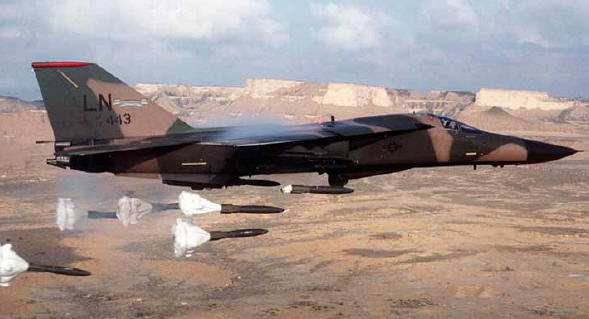


Terrain Following Capability


The F-111 was capable of flying at near 60,000 feet or close to the deck at supersonic speed with the use of its advanced terrain-following radar.  This also gave it true all-weather capability as well as being able to fly night sorties.  It was used extensively in night attacks during Desert Storm to strike numerous strategic Iraqi targets.


C-135 Stratotanker


The U.S. Air Force employed the F-111 in the Strategic Air Command as an interim bomber prior to the arrival of Rockwell's B-1.  It had neither the range or payload of a strategic bomber but its ability to fly at supersonic speed 100 feet above the deck gave it enormous ability to penetrate air defenses and reach its target.  During the Cold War F-111 wings were generally stationed in England within range of Warsaw Pact targets.


Side-by-Side Cockpit


The F-111 does not have ejection seats.  Instead, crew members sit inside a pressurized, air-conditioned module that can separate from the aircraft with the aid of rocket boosters.  Navy specifications required the watertight module to have flotation devices and the Air Force retained this ability.  
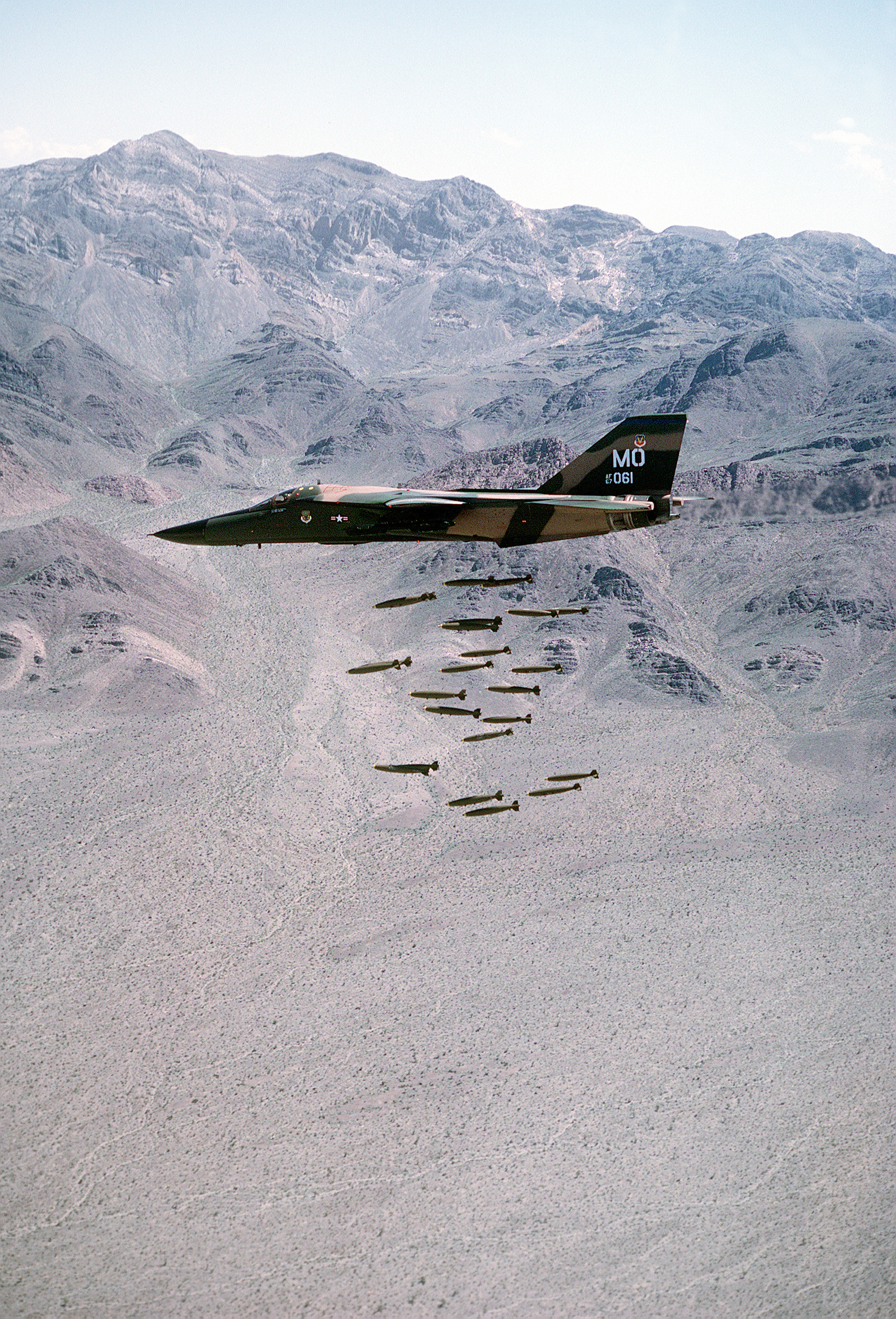


MK-82 500 lb bombs


During operation Desert Storm F-111s with laser-guided weapons were used to knock out hardened aircraft shelters and bunkers.  Having eliminated these Iraqi resources they moved to targeting Iraqi armor in night attacks.  Specialized 'Varks, the EF-111A Raven, provided the Wild Weasel role of blinding opposing forces' air defense radar during ground strikes.  


Inner pylons pivot with wing


The inner pylons pivot as the wing changes from 13 degrees to 72 degrees in order that the ordnance remains parallel with the fuselage.  The two optional outermost pylons do not have this capability but they can be ejected from the wing.  The F-111 was the first of the swept-wing combat aircraft, capable of adjusting wing angle to maximize performance.


Retired 1996


The F-111 became the unintended bridge between the expensive B-58's early demise and the delayed introduction of the B-1 bomber.  562 F-111s were ultimately built but it never served the original role of an air superiority fighter.  Exclusive reliance on air-to-air missiles was proven to be premature in the skies over North Vietnam and the design of the F-111 was not that of a dogfighter.  Instead, its 2.5 Mach speed and advanced terrain following avionics made it a formidable opponent in its role of striking high value ground targets.


A V I A T I O N


OVER EASY


Monday, January 9, 2012

F-16

F-16 Falcon


General Dynamics / Lockheed Martin


F-16 Falcon


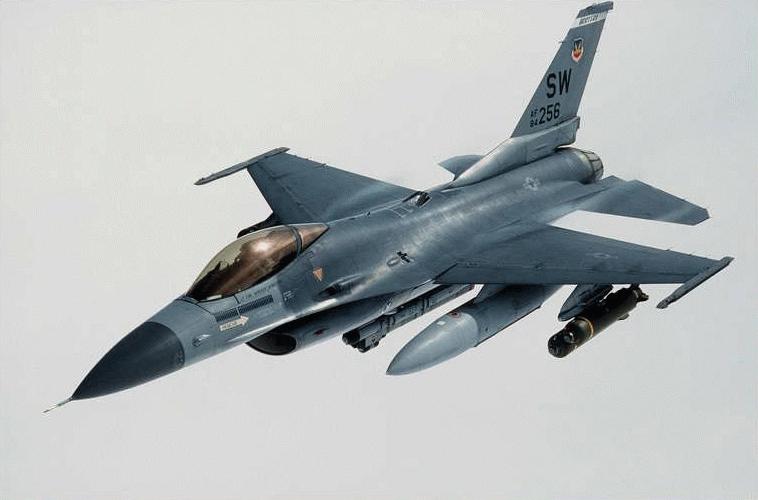
Since it's introduction thirty years ago 4,500 of these aircraft have been sold to the U.S. Air Force and other nations of the world.  It is a highly maneuverable, high performance jet with a proven combat record and at under $20 million per unit it is less expensive than many other Western jets.  


F-16A

Crew:                    1

Power:                  Pratt & Whitney 10,824 kg / 23,830 lb afterburning thrust
                              F100-PW-100 turbofan engine

Max. Speed:        2125 kph / 1320 mph
Ceiling:                 15,250 m / 50,000 ft
Range:                  580 km / 360 miles
Climb:                   15,250 m / 50,000 ft per minute

Weight -
Empty:                  6607 kg / 14,567 lb
Max. Take Off:     14,968 kg / 33,000 lb

Size -
Wingspan:           10 m / 32 ft 10 in including wingtip air-to-air missiles
Wing Area:          28.9 sq m / 300 sq ft
Length:                 15.03 m / 49 ft 4 in
Height:                 5.01 m / 16 ft 5 in

Armament:
                             1 - 20 mm / 0.78 in cannon
                             9 - hardpoints
                             5435 kg / 12,000 lb air-to-air missiles, bombs, rockets


V I D E O


AGM-65 Maverick


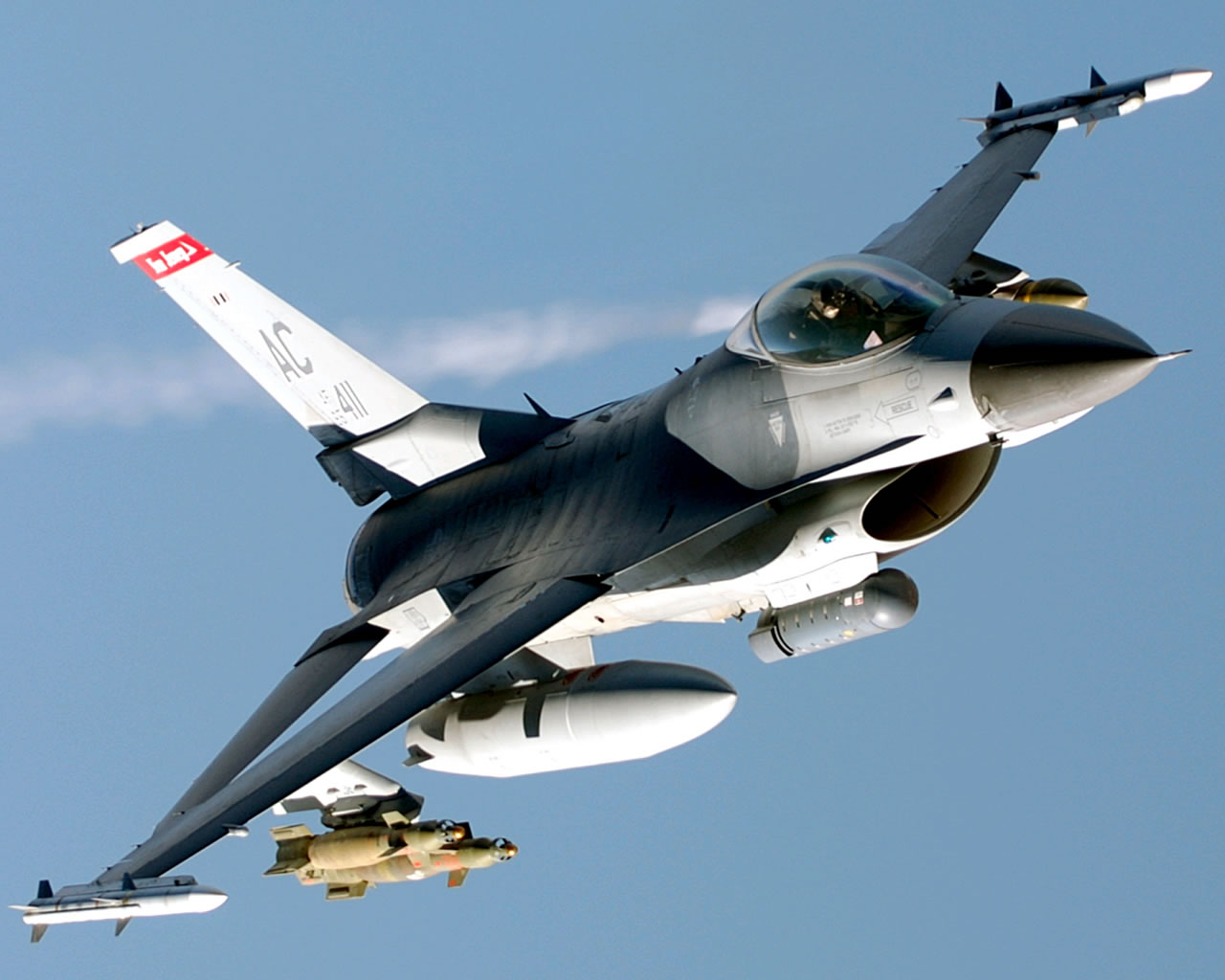
Designed to initially be a lightweight dogfighter the U.S. Air Force wanted the additional weight and size needed for the F-16 to become a respectable aircraft for ground support missions.  They preferred not to risk the more expensive F-15 being shot down in a close air support role.  During Operation Desert Storm in 1991 the Falcon, or Viper as pilots call it, flew more sorties than any other aircraft any many of these attacked ground targets.


AIM-7 Sparrow missile


The bubble canopy gives the pilot unobstructed vision and the 30 degree seat-back angle enables greater G-force tolerance.  The aircraft itself can withstand up to 9 Gs with a full load of internal fuel.  Using proven systems from the F-15 and F-111 reduced development time and cost in designing the F-16.


Side-Stick Controller


The F-16 was one of the first warplanes featuring fly-by-wire controls where a computer interprets the pilot's instructions to operate the flight controls.  The conventional flight stick has been replaced by a side-stick controller to provide easier, more accurate control during high G-force maneuvers.  The fly-by-wire control system does set envelope testing performance limits that make it less capable than the best Russian fighters.


Conformal Fuel Tanks


Lack of internal fuel capacity in the F-16 has been a limitation that this aerodynamic add-on attempts to remedy.   Adding size and bulk enhances its ground support role while diminishing its original intention of being a lean, lightweight high-performance dogfighter.  Its flexible design has enabled it to maintain sales over thirty years.  


Unscheduled Departure


In 2003 Poland became the first former Warsaw Pact nation to purchase the F-16.  President Carter agreed to the sale of F-16s to Israel in 1980 to replace their aging A-4s and Mirage IIIs.  The following year Israel used their new aircraft to destroy Iraq's nuclear reactor then under construction.  In 1982 Israel's F-16s were credited with downing 44 Syrian MiGs over the Bekaa Valley.  


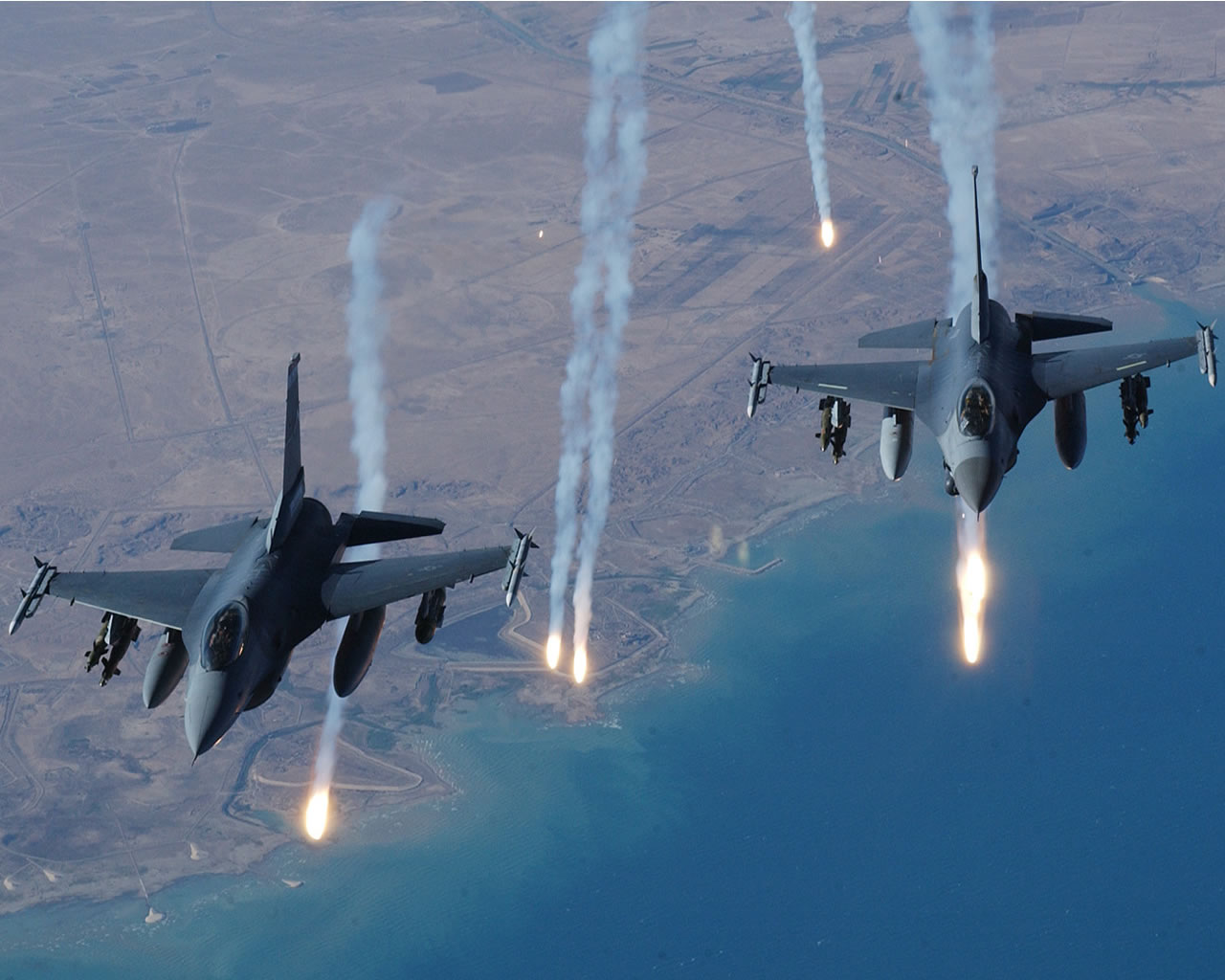
Flares


As of 2003 the F-16 has shot down 69 aircraft in aerial combat without a loss.  It has gained two tons in weight since its inception but its overall capability has increased.  It has become the most numerous of Western interceptors since first replacing the F-104 Starfighter.  


Armed for Ground Support


The F-16 is expected to be replaced by the F-35 Joint Strike Force fighter over the next few years.  This new fifth generation fighter has been delayed by developmental problems which is not surprising with sophisticated military hardware.  With the F-35 coming in at over $120 million per copy, several times the cost of an F-16, it is not surprising this Pentagon project has come in for criticism.  The question remains whether the United States, given its current battle with deficits, will stick with its original intention of purchasing 2,400 of these aircraft.    


A V I A T I O N


OVER EASY


Sunday, January 8, 2012

F-22

F-22 Raptor


Lockheed Martin / Boeing


F-22 Raptor


The most advanced fighter that exists is the stealth designed F-22.  The cost of $150 million per unit helped to halt production in 2011 at 187 aircraft.  While fifth generation fighters are being developed by both Russia and China their aircraft are not seen as a near-term threat.


F-22


Crew:                    1

Power:                  2 - Pratt & Whitney 16,095 kg / 35,438 lb afterburning thrust 
                                    F119-100 turbofans

Max. Speed:        Mach 2
Ceiling:                15,250 m / 50,000 ft
Range:                 not available
Climb:                  not available

Weight -
Empty:                 14,395 kg / 31,760 lb
Max. Take Off:    27,216 kg / 60,000 lb

Size -
Wingspan:          13.56 m / 44 ft
Wing Area:         78 sq m / 840 sq ft
Length:                18.92 m / 62 ft 1 in
Height:                 5 m / 16 ft 5 in

Armament:
                            1 - 20 mm / 0.78 in cannon
                            4 - AIM-9 Sidewinders carried in side bays
                            4 - AIM-120 AAMs or
                            6 - AIM-120s in ventral weapons bay
                            4 - underwing hardpoints for additional ordnance


V I D E O


Sidewinder


Four weapons bays house ordnance to maintain the aircraft's stealth characteristics although four hardpoints beneath the wings allow for external weapons.  Advanced avionics enable a lone pilot to perform a mission normally requiring a two man crew.  The end of the Cold War reduced the Raptor's need and its initial order of 339 aircraft was cut nearly in half.


Vertical Thrust Vectoring Nozzles


The design is optimized for maneuverability in low speed combat with vectoring engine exhausts.  The engines also provide supersonic cruise capability without the use of fuel guzzling afterburners.  They are also designed for relative ease of maintenance.


High-Intensity Monitor Displays


The Raptor cockpit includes a holographic Head-Up Display - HUD, as well as providing for HOTAS controls - Hands on Throttle and Stick, enabling the pilot to issue commands without releasing flight controls.  The F-22's radar system provides the pilot information on approaching aircraft well before the opposing pilot is aware of any threat.


Inspection 


Ground crews are able to monitor the Raptor's status using a laptop computer as well as undertake diagnosis of system faults.  The aircraft is primarily composed of composites, titanium alloys and radar absorbent materials.  The frameless canopy also reduces radar reflection.


B-2


Both the F-22 and the B-2 represent a revolution in aircraft design made possible by advances in computer technology.  Their enormous expense and limited role given the current world situation makes their future uncertain.  Aircraft such as the F-35 are more likely to be called upon to fulfill the role of tactical fighter. 


Flares


Although the F-22 is capable of providing ground support it is not likely the Air Force would volunteer a $150 million aircraft for such a high risk mission.  Close Air Support is becoming the exclusive role of helicopters like the AH-64 Apache which has the advantage of being able to linger near ground targets.


A V I A T I O N


OVER EASY


Wednesday, January 4, 2012

Two Party System

Pragmatic trumps Ideology
The Iowa Caucus is the first attempt at reducing the nation’s choice for President to two.  The United States is a nation diverse in ethnicity, culture and economics.  Yet, every four years two parties provide the finalists in the contest for leadership.  The argument among a party’s early candidates include the expected position on issues, to one of ideological purity, and that of electability in the general election.  While an uncompromising ideological stance excites the party’s most passionate followers, it is electability that is the greater concern among party professionals.  The likelihood of being elected to the White House also affects the party make-up of the Congress.  A strong presidential candidate can make the difference in outcome of closely fought House and Senate contests in a number of ways.  Popular candidates draw additional supporters to the polls on election day.  They energize rank and file volunteers to give more freely of their time in doing the many tedious tasks necessary to make a campaign successful.  There’s nothing like the sense if imminent victory to propel the candidate and his followers to higher levels of purposeful energy.
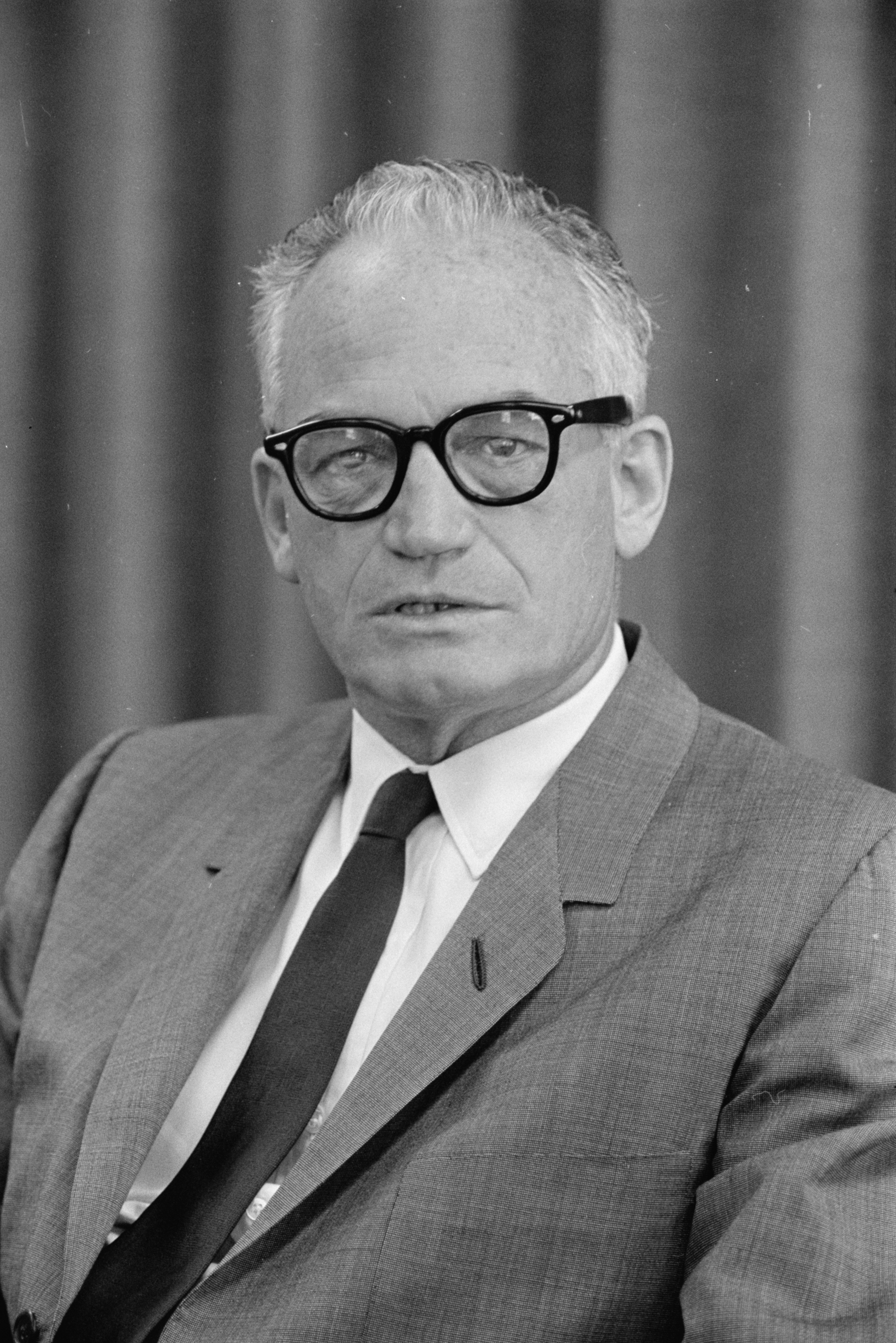
The history of presidential elections indicates a party can be assured of forty percent of the vote in November no matter who they nominate.  This can be seen as the party’s base support.  It is up to the candidate for President to gain the additional ten percent of the electorate in order to win.  In present day America neither party commands a fifty percent ideological following.  Unlike House races and even state-wide Senate races, this nation of three hundred million people stretching the breadth of a continent has too many competing interests to easily coalesce within a narrow political view.  The candidate espousing rigid principles usually succumbs during the course of the nominating process to the candidate more likely to bring party victory in the Fall.  Two elections in the past fifty years stand out as examples of ideological candidates gaining their party’s nomination for president over more centrist alternatives.  The first would be Barry Goldwater in 1964 and the second, George McGovern in 1972.  In each instance the party was unable to expand its base beyond the minimal forty percent and many of its candidates for House and Senate seats went down to defeat in the resulting landslide victory for Lyndon Johnson in ’64 and Richard Nixon in ’72.
The present day contest for the Presidential nomination in the Republican Party once again illustrates the dynamic of this process.  While Mitt Romney appears headed for his party’s choice for President this year it is equally evident that he is the heart-felt choice of only a few.  His  task is to thread his beliefs in such a fashion as to lull the suspicions of many activist voters of his chosen party.  Romney’s challenge is not unlike that of Dwight Eisenhower in 1952.  While Eisenhower was an authentic war hero with enormous popularity he was still regarded by many in the GOP as not being a true Republican.  Many of these party faithful gave Ike the nomination even while they preferred the more conservative Robert Taft of Ohio.  Eisenhower went on to win the Presidency with landslide margins – twice. 

The value of the two party system may well be in its emphasis on pragmatic considerations over philosophical beliefs.  Time and again it has forced the voter to accept a half filled glass to quench their enormous thirst.  This fact may be why nearly half the eligible voters never register their preference on election day.  Or maybe some do.  For them not voting can be taken to mean ‘none of the above’.                    


Picture Sources:  All Wikipedia


Monday, January 2, 2012

21st Century Air Force


E-2C Hawkeye


Obtaining information on potentially hostile forces is a daily air force routine.  Using jets for tactical reconnaissance is dangerous but a necessary risk.  Spy satellites can't begin to provide the quantity of information demanded by the military.  Their expense makes them too few in number and they are available only as their orbit permits.  UAVs, or Unmanned Aerial Vehicles, are increasingly relied upon for reconnaissance because they don't endanger a pilot's life and are less expensive than manned jets.  They have the added benefit of being inconspicuous while lingering over a site.    


F-4 Phantom and MiG 17


The most important mission of an air force is to control air space.  Air supremacy prevents aerial attack on one's own forces while allowing friendly aircraft to destroy the opposition's resources on the ground.  The first priority of an air force is to destroy the opposing air force - eliminating its aircraft and wrecking its bases of operation.  Battles on the ground are usually won by the side that controls the air.


F/A-18


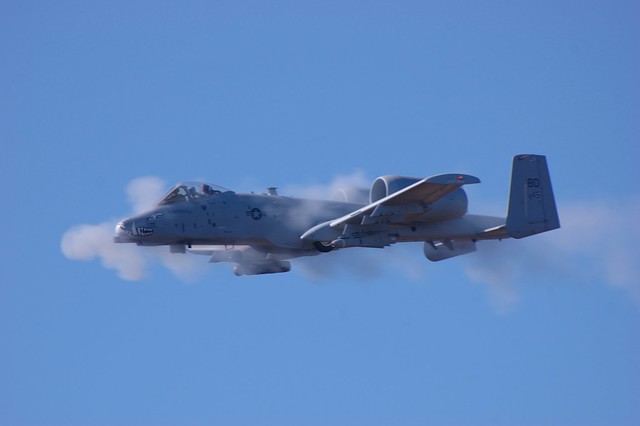
Ground attack is high risk.  Diving toward earthbound targets is the combat role least favored by most pilots.  One is subjected to fire from every direction when delivering ordnance close to the deck.  A hard to replace pilot and his aircraft can be destroyed by inexpensive small arms fire.  The Air Force much prefers purchasing high performance jets for aerial combat to something resembling a flying tank.  Available technology is better suited to prevent downing by surface to air missiles and enemy interceptors than trying to dodge everything including a kitchen sink.


A-10


AH-64


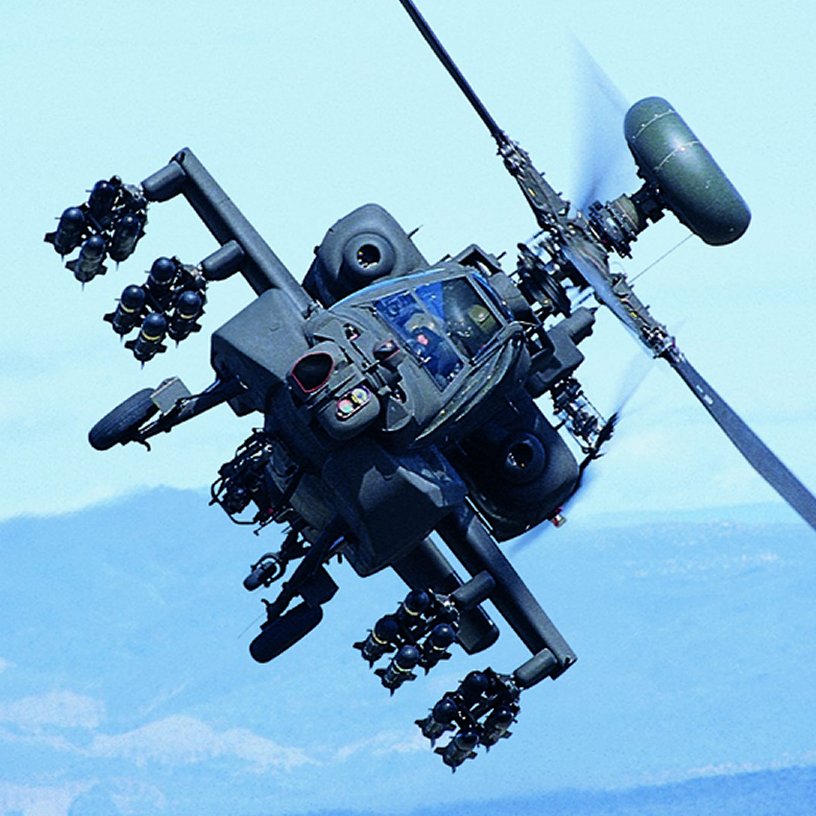
With the retirement of the A-10 Warthog close air support of ground troops is being relegated to helicopters.  While U.S. Marines can call on their own air force for additional fire power the U.S. Army has no comparable control of fixed winged aircraft.  The solution has been the development of attack helicopters such as the AH-64 Apache shown above.  The USAF is only too happy to cede this role to the Army.


F-15


Combat jets are by far the most expensive and complicated weapon system in the military.  The airframe is just the beginning.  Advanced avionics and sophisticated ordnance easily adds several million to the price tag.  Maintaining combat readiness involves regular overhauls, system upgrades and constant maintenance by highly skilled technicians to keep the aircraft air worthy.  Their ability to deliver decisive fire power and to be most anywhere on short notice means they are in constant demand.  Their expense guarantees their supply never meets that demand.  


F-16 Ground Crew


An aircraft's performance is dependent upon factors of readiness.  Like automobiles combat jets vary widely in reliability and the expense of keeping them maintained.  Western jets bring unbeatable performance but at a cost affordable to only the most financially well-off nations.  An expensive jet is only as capable as the pilot controlling it.  Pilot training is also an enormous expense and the flight time they need to sharpen their skills is often sacrificed to tight budgets.  This proves to be false economics as highly trained pilots consistently sweep their less experienced counterparts from the sky.


E-8C JSTARS


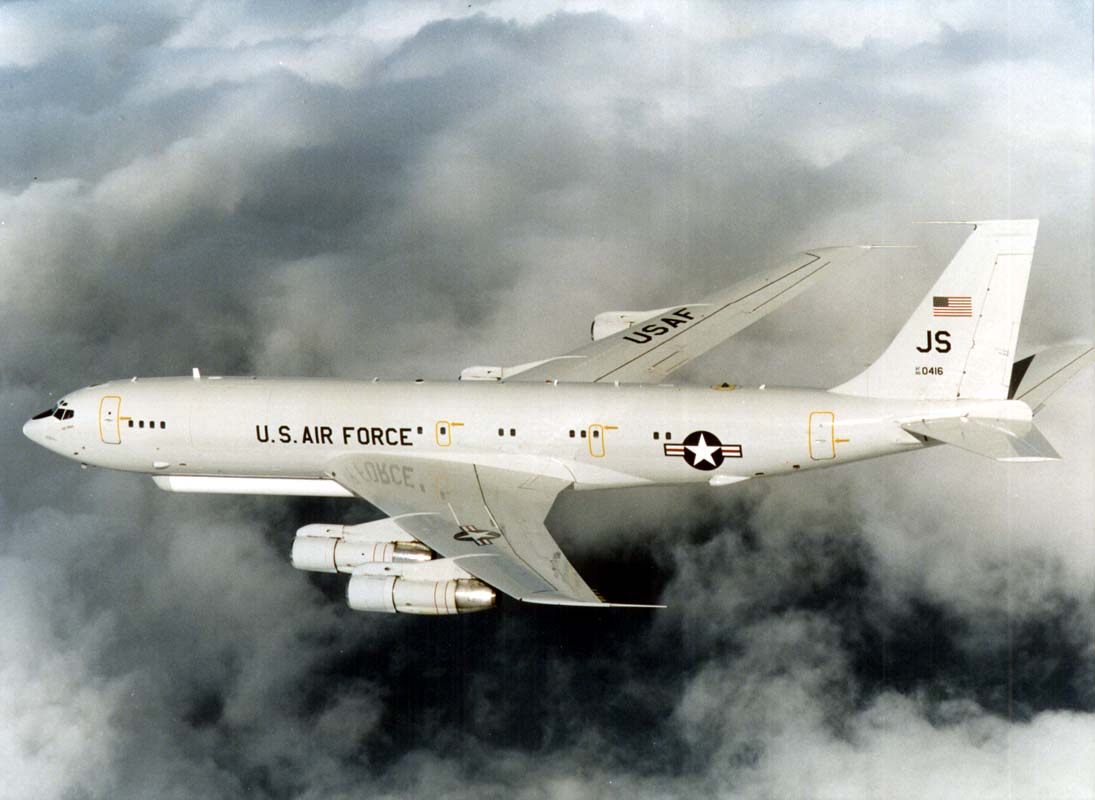
Sophisticated command and control operations increasingly direct pilot actions.  Radar dominates air warfare.  Airborne control operations not only track all friendly and hostile aircraft but can also monitor and identify forces on the ground, as well.  This real-time information capability is of value only when shared with combat pilots who are then directed to these targets of opportunity.


A V I A T I O N


OVER EASY