Showing posts with label General Dynamics. Show all posts

Tuesday, January 10, 2012

F-111

F-111 Aardvark


General Dynamics


F-111 Aardvark


In 1960 the Air Force wanted a plane that could provide air superiority and be capable of both conventional and nuclear bombing missions.  This is at a time when missiles were believed to have made close air combat obsolete.  Thus we have the F-111 designation for this plane that never really performed the role of fighter.  As a cost saving move Secretary of Defense Robert McNamara decided the jet should replace the Navy's F-4 Phantom, despite Navy objections.  Eventually weight killed the idea of the F-111 being a carrier based plane and the Grumman F-14 Tomcat came into being.  


F-111F


Crew:                    2 - Pilot, Weapons Officer

Power:                  2 - Pratt & Whitney 11,395 kg / 25,100 lb afterburning thrust
                                   TF30-P-100 turbofans

Max. Speed:        2655 kph / 1650 mph
Ceiling:                17,995 m / 59,000 ft
Range:                 4707 km / 2925 miles
Climb:                  6710 m / 22,000 ft per minute

Weight -
Empty:                21,417 kg / 47,175 lb
Max. Take Off:   45,400 kg / 100,000 lb

Size -
Wingspan:          19.2 m / 63 ft, spread
                             9.74 m / 32 ft, swept
Wing Area:         48.77 sq m / 525 sq ft
Length:                22.4 m / 73 ft 6 in
Height:                5.22 m / 17 ft 1 in

Armament:
                            1 - 20 mm / 0.78 in cannon
                            1 - nuclear bomb or
                            2 - 340 kg / 750 lb bombs in internal bomb bay
                            4 - underwing pylons for rockets, missiles or fuel tanks


V I D E O


First Variable Geometry Wing


The F-111 might best be described as a tactical strike aircraft with long range capability.  It was respected by its pilots and its adversaries and it proved itself in an action against Libya in 1986 and five years later in operation Desert Storm.    Shortly after becoming operational six of these aircraft were rushed to southeast Asia in March, 1968.  They were withdrawn the following month after three had been lost.  Several years later they were reintroduced as part of the Linebacker II bombing campaign over North Vietnam.  Despite losses during the course of 3,000 missions their deployment was considered successful.


Terrain Following Capability


The F-111 was capable of flying at near 60,000 feet or close to the deck at supersonic speed with the use of its advanced terrain-following radar.  This also gave it true all-weather capability as well as being able to fly night sorties.  It was used extensively in night attacks during Desert Storm to strike numerous strategic Iraqi targets.


C-135 Stratotanker


The U.S. Air Force employed the F-111 in the Strategic Air Command as an interim bomber prior to the arrival of Rockwell's B-1.  It had neither the range or payload of a strategic bomber but its ability to fly at supersonic speed 100 feet above the deck gave it enormous ability to penetrate air defenses and reach its target.  During the Cold War F-111 wings were generally stationed in England within range of Warsaw Pact targets.


Side-by-Side Cockpit


The F-111 does not have ejection seats.  Instead, crew members sit inside a pressurized, air-conditioned module that can separate from the aircraft with the aid of rocket boosters.  Navy specifications required the watertight module to have flotation devices and the Air Force retained this ability.  
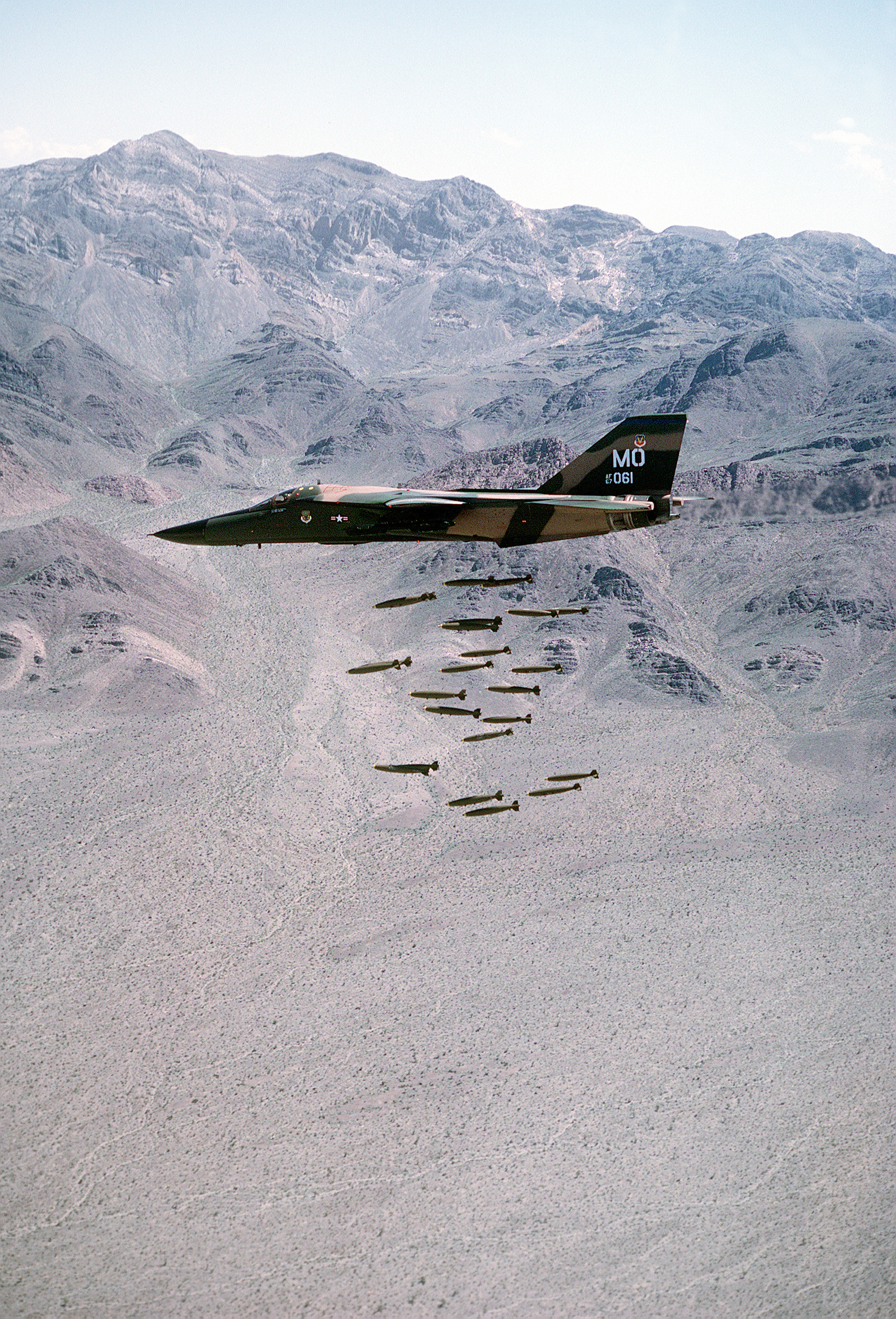


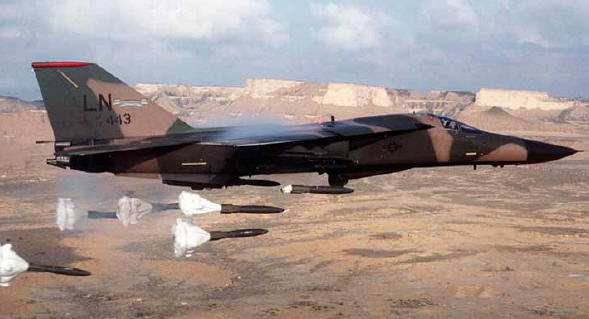
MK-82 500 lb bombs


During operation Desert Storm F-111s with laser-guided weapons were used to knock out hardened aircraft shelters and bunkers.  Having eliminated these Iraqi resources they moved to targeting Iraqi armor in night attacks.  Specialized 'Varks, the EF-111A Raven, provided the Wild Weasel role of blinding opposing forces' air defense radar during ground strikes.  


Inner pylons pivot with wing


The inner pylons pivot as the wing changes from 13 degrees to 72 degrees in order that the ordnance remains parallel with the fuselage.  The two optional outermost pylons do not have this capability but they can be ejected from the wing.  The F-111 was the first of the swept-wing combat aircraft, capable of adjusting wing angle to maximize performance.


Retired 1996


The F-111 became the unintended bridge between the expensive B-58's early demise and the delayed introduction of the B-1 bomber.  562 F-111s were ultimately built but it never served the original role of an air superiority fighter.  Exclusive reliance on air-to-air missiles was proven to be premature in the skies over North Vietnam and the design of the F-111 was not that of a dogfighter.  Instead, its 2.5 Mach speed and advanced terrain following avionics made it a formidable opponent in its role of striking high value ground targets.


A V I A T I O N


OVER EASY


Monday, January 9, 2012

F-16

F-16 Falcon


General Dynamics / Lockheed Martin


F-16 Falcon


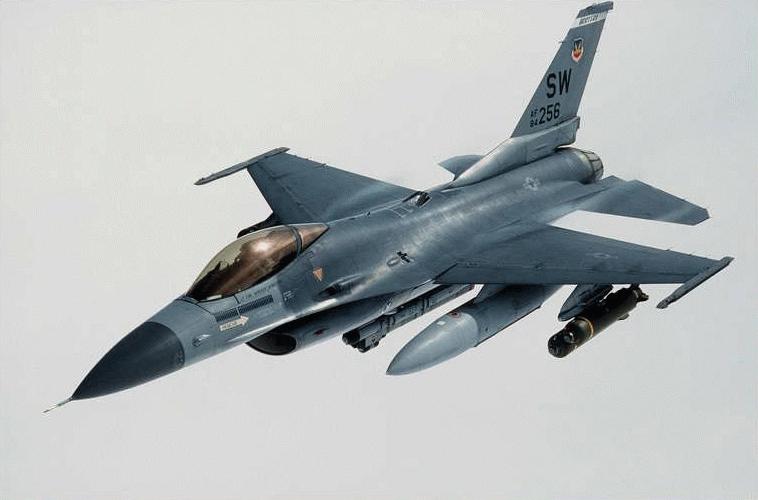
Since it's introduction thirty years ago 4,500 of these aircraft have been sold to the U.S. Air Force and other nations of the world.  It is a highly maneuverable, high performance jet with a proven combat record and at under $20 million per unit it is less expensive than many other Western jets.  


F-16A

Crew:                    1

Power:                  Pratt & Whitney 10,824 kg / 23,830 lb afterburning thrust
                              F100-PW-100 turbofan engine

Max. Speed:        2125 kph / 1320 mph
Ceiling:                 15,250 m / 50,000 ft
Range:                  580 km / 360 miles
Climb:                   15,250 m / 50,000 ft per minute

Weight -
Empty:                  6607 kg / 14,567 lb
Max. Take Off:     14,968 kg / 33,000 lb

Size -
Wingspan:           10 m / 32 ft 10 in including wingtip air-to-air missiles
Wing Area:          28.9 sq m / 300 sq ft
Length:                 15.03 m / 49 ft 4 in
Height:                 5.01 m / 16 ft 5 in

Armament:
                             1 - 20 mm / 0.78 in cannon
                             9 - hardpoints
                             5435 kg / 12,000 lb air-to-air missiles, bombs, rockets


V I D E O


AGM-65 Maverick


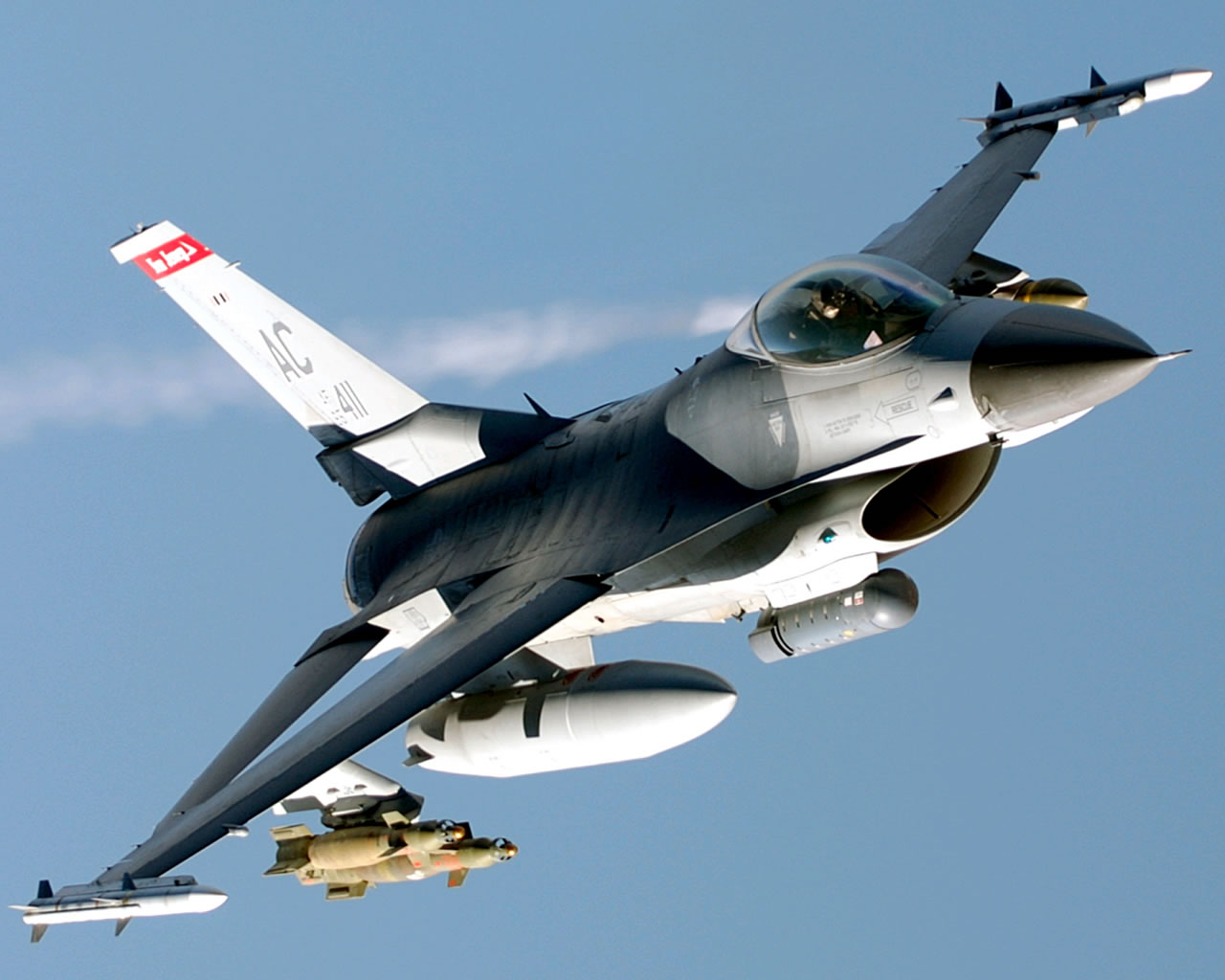
Designed to initially be a lightweight dogfighter the U.S. Air Force wanted the additional weight and size needed for the F-16 to become a respectable aircraft for ground support missions.  They preferred not to risk the more expensive F-15 being shot down in a close air support role.  During Operation Desert Storm in 1991 the Falcon, or Viper as pilots call it, flew more sorties than any other aircraft any many of these attacked ground targets.


AIM-7 Sparrow missile


The bubble canopy gives the pilot unobstructed vision and the 30 degree seat-back angle enables greater G-force tolerance.  The aircraft itself can withstand up to 9 Gs with a full load of internal fuel.  Using proven systems from the F-15 and F-111 reduced development time and cost in designing the F-16.


Side-Stick Controller


The F-16 was one of the first warplanes featuring fly-by-wire controls where a computer interprets the pilot's instructions to operate the flight controls.  The conventional flight stick has been replaced by a side-stick controller to provide easier, more accurate control during high G-force maneuvers.  The fly-by-wire control system does set envelope testing performance limits that make it less capable than the best Russian fighters.


Conformal Fuel Tanks


Lack of internal fuel capacity in the F-16 has been a limitation that this aerodynamic add-on attempts to remedy.   Adding size and bulk enhances its ground support role while diminishing its original intention of being a lean, lightweight high-performance dogfighter.  Its flexible design has enabled it to maintain sales over thirty years.  


Unscheduled Departure


In 2003 Poland became the first former Warsaw Pact nation to purchase the F-16.  President Carter agreed to the sale of F-16s to Israel in 1980 to replace their aging A-4s and Mirage IIIs.  The following year Israel used their new aircraft to destroy Iraq's nuclear reactor then under construction.  In 1982 Israel's F-16s were credited with downing 44 Syrian MiGs over the Bekaa Valley.  


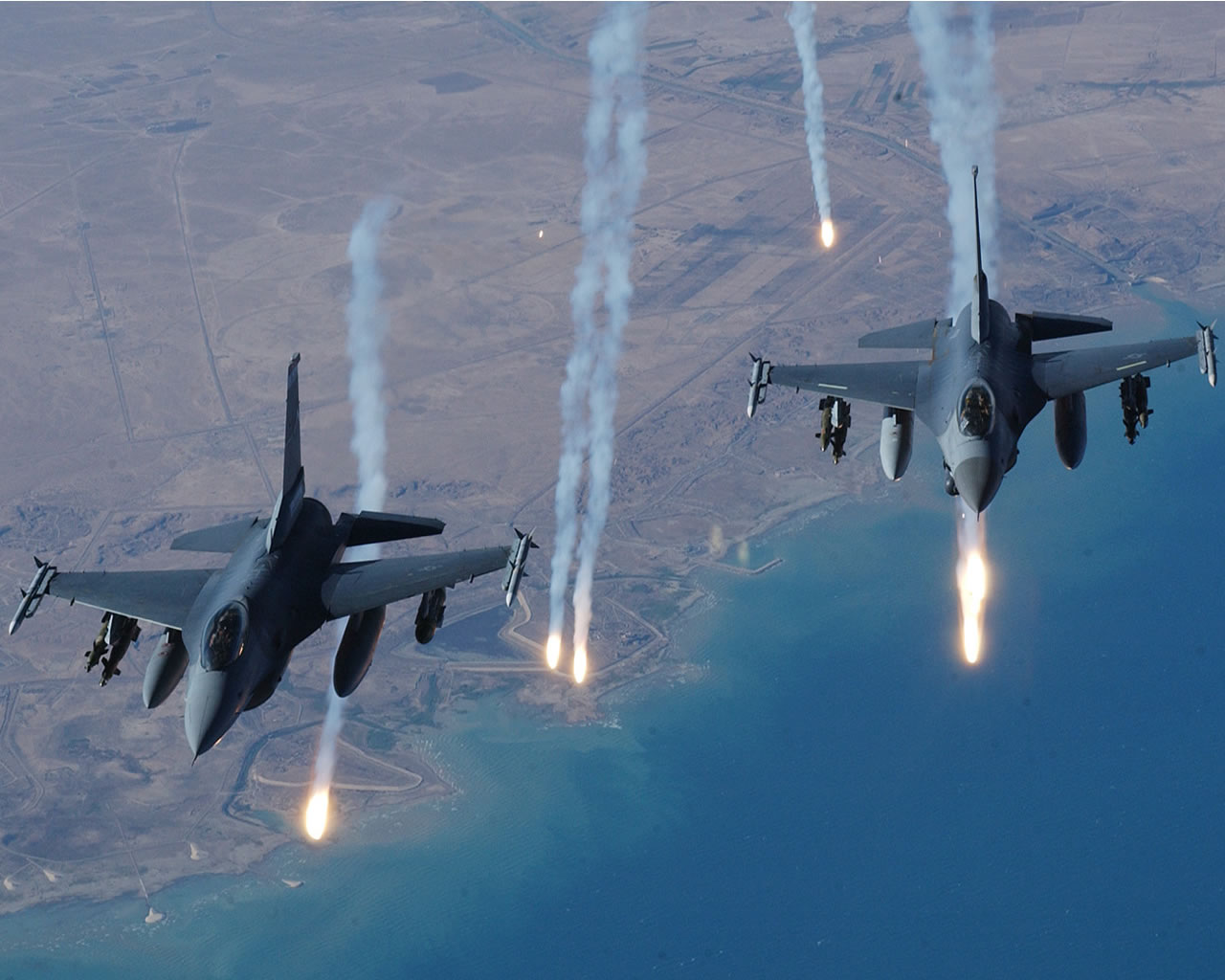
Flares


As of 2003 the F-16 has shot down 69 aircraft in aerial combat without a loss.  It has gained two tons in weight since its inception but its overall capability has increased.  It has become the most numerous of Western interceptors since first replacing the F-104 Starfighter.  


Armed for Ground Support


The F-16 is expected to be replaced by the F-35 Joint Strike Force fighter over the next few years.  This new fifth generation fighter has been delayed by developmental problems which is not surprising with sophisticated military hardware.  With the F-35 coming in at over $120 million per copy, several times the cost of an F-16, it is not surprising this Pentagon project has come in for criticism.  The question remains whether the United States, given its current battle with deficits, will stick with its original intention of purchasing 2,400 of these aircraft.    


A V I A T I O N


OVER EASY