Showing posts with label Picasso. Show all posts

Saturday, December 27, 2014

Outlaws with Paint


Vlaminck     The Orchard     1905

What do you make of using all this intense color to create a landscape?  The reds, blues and yellows are like those found in a basic box of crayons.  They are chosen for reasons other than depicting trees and brush.  Emotion is expressed here; that of the artist and of the viewer, as well.  Blue and green constrain the energy of red and yellow.  That’s a start.  The frenetic, oil laden brush strokes stir up an overall agitation.  The trunk of the tree gives our eyes a resting spot.  It’s 1905 and this is the work of Maurice de Vlaminck – one of the early practitioners of Fauvism.  The expressive brushwork reminds us of van Gogh but the charged colors point elsewhere for its source.  We’ll be looking for someone unconcerned with dimension.  His choice of colors might seem arbitrary.


van Gogh     Self Portrait     1889

van Gogh     Wheat Field     1889

Let’s first look to van Gogh.  He shows little concern for modeling form.  Such an approach would distract from the mood he intends to convey.  The mountains flow as a river, separating the sharp glint of sky from the warm turbulence of wheat ready for harvest.  Amidst it all a man swings his scythe.  Can he be representing us?  We are strangers on this Earth.  Our life a pilgrim’s progress – a passage from Earth’s womb to the uncertain realm that is God’s.   Of course it could just be the scene of a man reaping the late summer harvest.


Gauguin     Tahitian Landscape     1897

Gauguin     Self-Portrait with Halo     1889

Gauguin freed color from representing nature.  Where van Gogh might choose deep blue to depict a mountain shadow Gauguin would ignore what he saw and instead provide a flat field of red if it suited his purpose.  His self-portrait of 1899 foretells the work of Henri Matisse by about fifteen years.  Decorative design substitutes for the illusion of form.  The painting insists on remaining flat.  Color is as much the topic as is Gauguin’s sardonic portrayal of himself.   


Matisse     Lady on a Terrace     1907

Why would one of the great Twentieth Century artists deliberately give his painting the look of a crude postcard?  Imagine the impact of the colors if the scene had been skillfully rendered.  Carefully considered design and color would be swept aside by our admiration for storyline and the masterful modeling of form and depth.  We might mistake landscape for the subject when Matisse is actually exploring the matter of yellows and reds. 


Matisse     Self-Portrait in a Striped T-Shirt     1906

Someone gave the name of ‘Wild Beasts’, or Fauves, to the followers of Matisse.  They were the Beastie Boys of Parisian art salons.  How could anyone find art in these garish pictures?  This is the work of anarchists who knowingly perpetrate fraud on those foolish enough to purchase these insults to Western civilization.    


Picasso     Self-Portrait     1907

Picasso     Nude Women     1906

Henri Matisse was undisputed leader of the Fauves while his greatest artistic rival defied categories and would be known simply as Picasso.  He mastered classical oil painting while still a youth living with his parents.  He could have made a splendid living for himself painting portraits of the wealthy.  Ha!  Look at this self-portrait.  Picasso is an arrogant son-of-a-bitch.  The only person good enough to judge his work is himself.  The best of his work dares you to say otherwise.  The Fauves may have coaxed him away from a rose palette but he would always be a movement of one – except for his brief collaboration with Georges Braque and the development of Cubism. 


Dufy     Self-Portrait     1899

Raoul Dufy would become one of the Beastie Boys of color.  A few years prior to his transformation he painted himself as a disdainful, callow youth with a pugnacious tilt of the hat.  Compare the image with that of Picasso.  They are of similar age.  One wishes to sell you on his self-assurance.  The other doesn't care what you think. 


Dufy     Boats at Martigues     1908

Dufy     Martigues

Now look at Dufy under the influence.  He’s absorbed the intensity of Vlaminck and the audacity of Matisse.  Such is the fire that burns within youth.  Dufy’s running with the bulls would be spectacular but short-lived.  He returned to the portrayal of substance.  Forms once again exhibited weight.  His return to the subjects of classical masters was refreshed with the influence of Cézanne.


Macke     Self-Portrait     1906

Macke     Woman with a Yellow Jacket     1913

August Macke is all of nineteen in this portrait he painted of himself.  Possibly he’s struggling at growing a beard.  It’s 1906 and the Fauves are the talk of the avant-garde.  Within a year he will be swept up by the excitement of the Paris art scene.  Macke is enraptured with color.  He composes luminous fields of reds, yellows and blues.  The people populating his paintings are barely implied.  His love affair with Fauvism lasts but a couple of years.  He’s intrigued by Robert Delaunay’s work at coloring Cubist structure.  Form once again matters.  See the woman before the window.  Look at all the unexpected facets that required his expertise in color.  What painter of illusion could resist this play of light and dark? 


Macke     Woman in front of a Large Window

Malevich     Self-Portrait     1910

Here’s the portrait of the Russian painter, Kazimir Malevich.  He’s giving us the look of serious intent.  The back of his mind, though, is filled with thoughts of sex.  How can you not savor the sensual backdrop he provides us?  Now view his study of the crucified Christ – it’s nearly drenched with runny yellow.  Everyone, including the pious old saints, is stripped to their unadorned flesh.  Kazimir will likely undress you with his eyes.  So what direction does this man of sensual desire take himself?  He arrives at the doorstep of Piet Mondrian – the artist celebrated for painting pure abstraction:  a few black lines, intersecting perpendicular to one another; a white background; a box or rectangle here and there, filled with basic blue or red or yellow.  For Malevich these compositions are music.  It views like Stravinsky sounds – a romance unadorned.  Malevich exiles all things organic.  Make abstract geometric.  Make it simple, simpler, simplest.  Finally, Malevich falls off the deep end with White Box on White.  The box is curiously set ajar.  Actually it’s not really a box because it doesn’t quite fit in the canvas.  It’s five-sided.  It only gives you the illusion of being square.  Brilliant!  Malevich gives us the simplest geometry, void of primary colors.  He nearly renounces the pictorial narrative.  Still, we have to ask ourselves, “Why is the box askew?”  Actually, it’s not a box.  It’s a square.  Wait!  It can’t be a square if there are five sides.  But there really are only four sides because part of the square is out of the picture.  Who says – the artist?  Hmm.  Guess who created a storyline out of radically minimal abstraction?

Malevich     Sketch for Fresco     1907

Malevich  White Box on White     1917


Sunday, December 7, 2014

Good Morning Jacob

Letter to my Son
Sunday, 7 December


Good Morning Jacob…

The rate of technological change we experience as individuals can give us the impression that humanity’s lot steadily improves.  Growth in scientific knowledge generally improves the quality of life by most people’s estimate.  Whether humanity has similarly progressed in the realms of politics, philosophy and the arts is something passionately argued.  These are areas guided as much by the human heart as they are by intellect.  Yet a convincing argument can be made that governance has benefitted from the development of democratic institutions; mankind is more compassionate when the inviolable rights of the individual are honored; and the visual arts has broadened its impact with the development of perspective, photography and motion pictures.  Who would argue we are better served if we turn back the clock and give up any of these developments?


Nicolas Poussin:  Orpheus and Eurydice - 1651

Nicolas Poussin’s 1651 painting, Orpheus and Eurydice, skillfully renders the illusion of a three dimensional world though painted onto a flat surface.  It takes full advantage of techniques developed by Renaissance artists, using single-point perspective as well as the lesser appreciated atmospheric perspective – acknowledging colors appear less saturated the further they are from the viewer.  The use of chiaroscuro, the treatment of light and shade, makes for a persuasive depiction of form.  Poussin provides a window onto his world, a civilization that celebrates the power of human reason to overcome age-old obstacles to mankind’s progress.  This approach was powerful during the Age of Enlightenment because it was a refreshing, inspirational view of mankind’s condition.  This expression by the masters of 16th century art became a convention that dictated the style of Western art for nearly three hundred years.  By the 19th century these methods were considered stale theater by artists demanding more personal expression; with its emphasis on creativity, sensuality, and immediate, authentic emotion.

Claude Monet:  Water Lillies - 1914

The Impressionists of the late 19th century created a new palette suited to portraying their spontaneous reaction to what their eye caught before them.  They moved their easels to the bright outdoors from their isolated studio and became enchanted with a landscape bathed with sunlight.  The shimmering light, the ever-changing tone and mood as the sun traveled across the sky, was intoxicating.  Impressionist painters like Monet abandoned most all considerations in order to capture light’s elusive effervescence.    

Vincent Van Gogh:  The Sower - 1888

The Dutch artist Vincent Van Gogh employed the Impressionist’s vivid colors to dramatically externalize his personal sympathies upon the landscape.  These works of the period burst forth with a passion that was suddenly free from deadening constraints.  The energies of youth radiated onto unvisited avenues with newly minted unimagined forms of creativity.  It was inevitable that someone substantial would eventually call a halt to the excesses and attempt to reinstate something of the traditional.

Paul Cezanne:  Houses at L'Estaque - 1880

Paul Cezanne felt Impressionism had abandoned much that was still essential to Western art.  The romance with color had pushed a reverence for form nearly out of the picture.  It was time to reestablish structure.  There was legitimate need for the illusion of substance, providing dimension on the flat painted surface.  Without dimension there is no dynamics.  Painting becomes a simple decorative design.  But the dark contrasts of chiaroscuro were out.  Cezanne would instead employ contrasting cool and warm colors to give a sense of depth and dimension.  His experiments would result in a fresh, recasting of Western art with a clean, simplified geometric look.  Detail was gone.  Verisimilitude:  sacrificed in favor of the sensual brushworking of oils onto canvas.  After all, we’re not making reality here.  We’re doing paint.

Chokwe Mask

 The colonialist ambitions of Europe exposed artists of Western civilization to new approaches of expressing the human form and psychology in art.  These mysterious, exotic masks and sculptures were exciting; powerful images, direct in their appeal and intuitive in their creation.  Flesh need not appear as flesh.  The head can be any assemblage of eyes, mouth and nose.  Extremes of imagination work to dramatize a human essence that is otherwise near impossible to portray.  About this same time Western thought is shaken with new ideas of the intellect.  Freud publishes his Interpretations of Dreams in 1900.  We are confronted with evidence that our minds remain basically instinctual and sexual desire permeates our everyday lives.  In that same year Max Planck’s revelations on the indeterminate nature of physical matter, his theory of Quantum Mechanics, undermines our Newtonian certitude.  Five years later Einstein releases his Special Theory of Relativity.  The conclusions are revolutionary.  Matter is a form of energy.  Space and time are related, not separate and distinct.  What time it is depends on where you are in the universe and how fast you are going.  We don’t all experience the same reality.

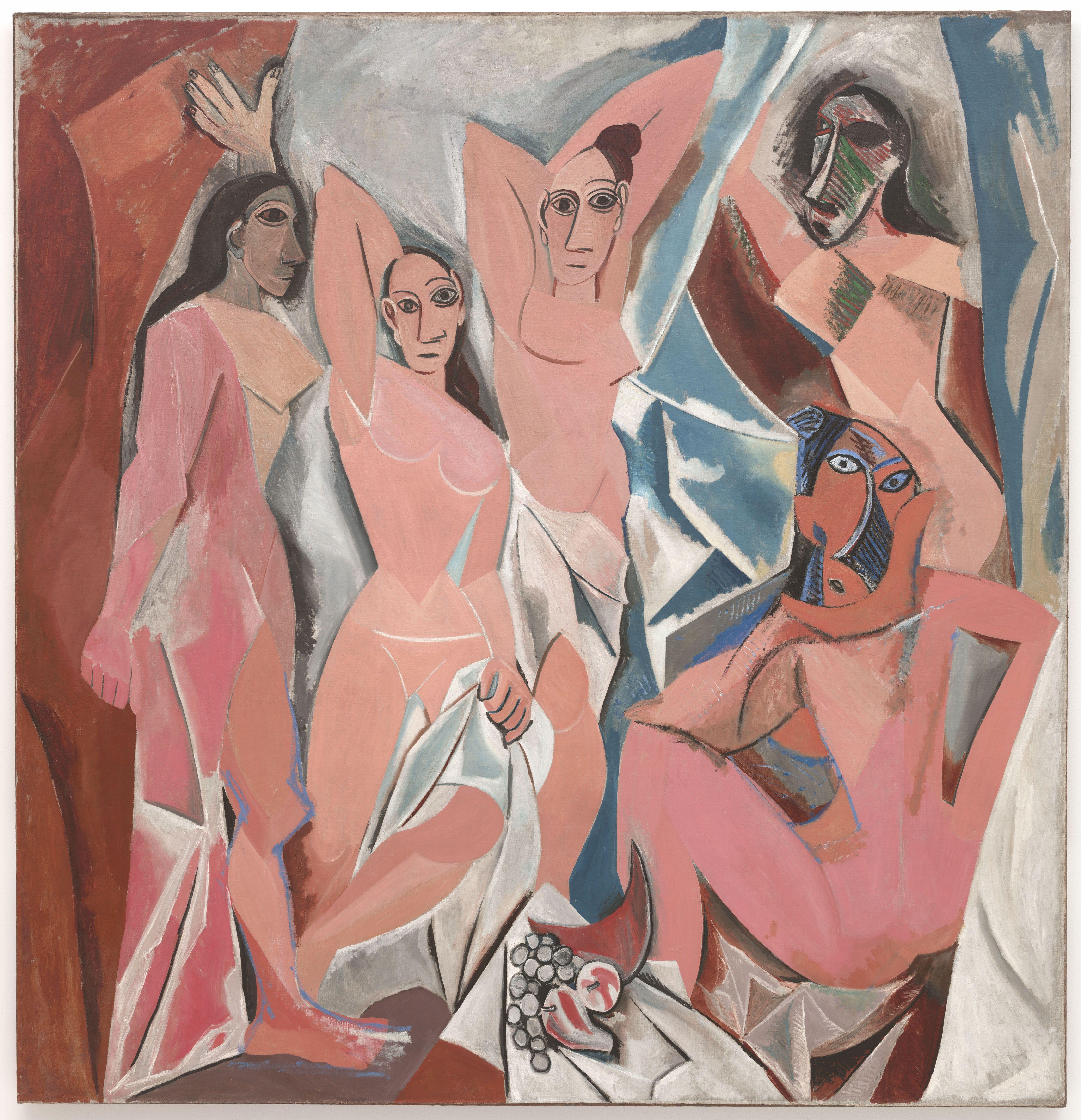
Pablo Picasso:  Les Demoiselles d'Avignon

Art is not created in a vacuum.  Artists may be made subliminally aware of dynamics that shift great civilizations like tectonic plates on a suddenly agitated molten sea.  Take a look at Picasso’s iconic statement of 1907.  No single 20th century painting portrays the unhinging of Western society from its traditional mooring like this bizarre portrayal of the women of Les Demoiselles d’Avignon.  We are here confronted by the nude women of a brothel.  Our anticipation of erotic pleasure is instead replaced with feelings of dread and anxiety.  Picasso has presented us with an indeterminate reality.  The love and tenderness we normally associate with femininity is replaced with judgmental stares and insinuations of barbaric acts.  Picasso bids good-bye to our long, confident love affair with the Enlightenment.  We are now cut adrift in a cold, uncertain world.

As it turns out the Twentieth Century was a time of both unparalleled human catastrophe and scientific progress.  Despite two global wars our civilizations rose to unprecedented heights in economic prosperity and technological development.  The art of the Western world has pursued numerous avenues of creative exploration, including cubism and various forms of abstraction.  Painters in oil have brought new approaches to representational art with works by artists ranging in vision from Lucian Freud to Francis Bacon.  Movies are all the rage and photography has democratized art.

Can we say these revolutionary strides in the visual arts demonstrate progress over the last couple of centuries?  Or is it reasonable to conclude, as did Picasso, that art has a timeless quality – it expresses an immutable human essence – traits not subject to alteration by scientific advancement.  Maybe the craft of art is more likened to the nature of a love shared by two people for one another.  Couples of long ago fell in love by the warmth of a fire, beneath the inky night stars.  Today they express their love sharing a bed, each with a smart phone in hand or casually browsing their iPad.  In each instance the need for love is maintained but its expression is determined by the nature of its context.

Love,
          Dad


Wednesday, February 27, 2013

Path to Cubism


Nicolas Poussin  1594 - 1665

A few years after Nicolas Poussin painted Landscape with Saint John in 1640 the French Royal Academy adopted the artist’s opinions as its ultimate authority on painting.  As a classicist painter Poussin believed his highest aim was to appeal to the rational mind, depicting the Platonic ideal, a view of what the world would be if only nature were perfect.  As such, his landscapes are as carefully arranged as stage props in a theater presentation.  People are captured in noble gesture, static as though modeled from ancient Greek or Roman statues.  They are as adverse to true emotion as is the corsage fixed to a chiffon swathed breast at the prom dance.

Landscape with St. John at Patmos  1640

Paul Cezanne  1839 - 1906

Paul Cezanne exiled himself from the Impressionist art scene of Paris, preferring an isolated existence in a village near Mont Sainte-Victoire, a mountain view he would obsessively paint time and again, an image that was often represented in his later work.  He wasn't interested in the charms of everyday life as depicted by Renoir or the play of light captured by Monet.  Cezanne was quite familiar with the works of art inhabiting the Louvre, including the paintings of Poussin, and he admired their solid, controlled approach.  But Cezanne wasn't interested in capturing the surface reality that fascinated both Impressionists and traditional painters alike.  He sought the inspiration given him by the natural world and portray it with a new reality of paint on canvas.  These works would not be expressions of rapture but, rather, a studied, deliberate analysis of form defined by color.  Cezanne would famously say that all objects of nature are based on cone, sphere and cylinder.  His exploration for qualities beneath the accident of appearance lead him to simplicities found in abstraction and a surface image mostly ignorant of perspective.  The paintings of Cezanne increasingly developed an identity independent of the objects they defined.

Sainte Victoire  1895

Les Demoiselles d'Avignon  1907

Georges Braque  1882 - 1963

1907 was a momentous year in the development of Georges Braque the artist.  This was the year he viewed a large retrospective of Cezanne’s work and was also exposed to Picasso’s challenging painting, Les Demoiselles d’Avignon, with its aggressive flattened figures and provocative mask-like images reflecting the influence of African sculpture.  Contained in the works of these two artists were the sensibilities that would influence much that was new to art in the 20th century.  Braque soon began his own investigation into painting a personal reality that quickly evolved into what became known as Cubism.  His Seaport, painted the following year, exhibited characteristics adopted by this new movement – pictorial details were eliminated to emphasize geometrical form, space was restricted to a flat picture plane and the palette was severely limited so that color would not distract from the exploration of forms.  His efforts attracted the attention of the young, ambitious Pablo Picasso.  Together, their search would lead them to the verge of total, non-objective art; art without visual reference to the natural world.  But neither were willing to take that final step of art that was purely art for art’s sake. 

Seaport  1908

Pablo Picasso  1881 - 1973

Picasso’s 1910 Portrait of Daniel-Henry Kahnweiler is as close as the artist would come to eliminating objects of the visual world from his canvas.  Details of the subject’s face are clearly present as are his clasped hands but the painting is mostly abstraction with little concern for depicting illusion.  Picasso’s interest in Cubism had, by now, peaked and he would soon leave any further exploration  of its potential to Braque.   Picasso was too much the story teller, too engaged with his imaginative, unique emotional expression of humanity to discard it all in favor of works meditating on the color blue or a simple black line crossing a field of white.  That would be a talent wasted – much like the loquacious writings of Walt Whitman or Allen Ginsberg being abandoned in favor of adopting the limited, austere poetry of Japanese haiku.  The artist must first know his own mind in order to choose his correct path.

Portrait of Daniel-Henry Kahnweiler  1910


Wednesday, March 7, 2012

Les Demoiselles d'Avignon

Les Demoiselles d'Avignon
Pablo Picasso
C L I C K     T O     E N L A R G E

Picture:  4500 x 4661 at 300 dpi - Wikipedia

Flat, faces marred with distortion, ragged line and color inappropriate for sensual thought.  The unappealing nude challenging the viewer to find sex here.  Yes, I see your armpit.  Why is that hand so awkwardly rising from on top the darkened, mask of a head?  You are a time warp with your ancient Egyptian stance and unblinking eyes of primitive figurines.  You are an oversized crumpled discard of a thought, mocking my humanity.

I strongly suspect this begins Picasso.  This is his door in the dream that we prefer not to walk through but can’t do otherwise.  We know our fears wait just beyond our view but we grasp the latch and swing open the door none the less.  We’re determined to confront our tearful, hideous dread.  So why the door?  What meaning does it have for us?  Maybe it provides the curtain lifting.  Even the exposure of truth requires some semblance of a show.  Every truth comes wrapped in a story.  For us there is no meaning, otherwise. 

What is the story of Les Demoiselles d’Avignon?  What story lies in the anonymous face of the dead?  Life placed in the human form becomes a magic show… filled with charm and delightful surprise.  Take life away and the form appears robbed of illusion.  Was it ever really what we thought? 

What is the beauty of this lullaby Picasso has painted?  Yeah, lullaby.  Do you not find a quieting stillness amidst this dissonance?  Humanity is to be found beckoning here.  It is much like Ginsberg’s rheumy-eyed vision of the soot covered near toothless sunflower.  We see what vision portrays for us only when we are ready.  The artist views a woman and with oil and brush portrays one’s own internal landscape.  If it is true it will hold a revelation for the artist as well as the woman portrayed.  Here is the young Picasso’s Sermon on the Mount, his parable that all life harbors a search so long as there is breath.