Showing posts with label Joseph Stalin. Show all posts

Tuesday, September 24, 2013

Hitler's War Strategy

World War II Europe


Russian troops at Stalingrad

Operation Barbarossa had a number of very ambitious goals that indicated the degree of contempt Hitler held for the military capability of the Soviet Union.  The primary goal was the destruction of the Red Army itself.  This would require rapid armored thrusts to envelope entire Soviet armies, preventing them from escaping into Russia’s interior by first crossing the Dvina and Dnieper Rivers.  Hitler was well aware of Napoleon’s mistake in capturing Moscow without first destroying the Russian army.    

The German Wehrmacht would itself be divided into three armies.  The northern-most command, Army Group North, would have the task of capturing Leningrad – depriving Stalin of an important arms production center and providing Germany with a port to supply its offensive operations.  Army Group Centre would have the preponderance of Panzer divisions which would be used to envelope Russian forces around Minsk and aid Army Group North in capturing Soviet forces in the Baltic region.  Army Group South would push towards Kiev then move south along the Dnieper River, encircling Russian forces in the Ukraine and destroying them.  Once these goals were achieved the three army groups would then converge on Moscow and destroy the remaining Red Army reserves used to defend the Russian capital. 

The Barbarossa campaign, launched in June 1941, was intended to achieve all its goals in the few short months prior to the Russian winter.  If time remained an effort would be made to capture the industrial region of the Donets Basin near the Black Sea and the oil fields of the Caucasus.  An achievement of this magnitude would require Soviet incompetence of epic scale and a literal implementation of lightening warfare.  The German use of Blitzkrieg tactics had its basis in strategic necessity.  Germany could not succeed in fighting long wars of attrition.  It hadn’t the resources.  Hitler gambled Britain and France would not declare war over his quick capture of Poland.  The surprise attack through the Ardennes was a plan designed to avoid a prolonged war with France in 1940.  Now Hitler counted on similar results when his forces smashed into Russia in 1941. 

As spectacular as the Wehrmacht’s successes were on the eastern front they fell well short of their needed goals.  Leningrad would be surrounded but never captured.  Moscow would remain out of reach of German troops and Army Group South struggled with unexpected resistance in the Ukraine.  The broad scope of Hitler’s expectations for Barbarossa proved unrealistic and would set the stage for the disastrous German summer campaigns of 1941 and 1942. 

Hitler’s focus in 1941 was economic.  The grain and mineral wealth of the Ukraine was vital to Germany’s success.  Hitler wanted the vast oil wealth beyond the Caucasus to fuel his own army and to deprive the Red Army of the energy needed to power a modern military.  His venture south led to the crushing defeat at Stalingrad where the entire German 6th Army was destroyed.  It was a demoralizing loss for Hitler and his troops as well as a victory that energized Stalin, the Red Army and the Russian people.

The decision by Hitler to launch an attack on the Kursk salient in 1942 was more a political decision than one driven by military opportunity.  The chances for German success in the operation were greatly reduced by Red Army preparedness for the attack and its vast increase in strength and skill.  The defeat at Stalingrad the previous year undermined the resolve of Axis allies to stand with Germany.   Hitler was particularly concerned with losing the support of Italy.  Britain and American forces were driving Rommel from North Africa and an Allied invasion of Western Europe seemed inevitable. 

German armored power was destroyed at Kursk.  The Wehrmacht would no longer be the equal of Soviet military forces.  The initiative would be forever lost to the Red Army.  The war in Europe would continue nearly another two years but, for Germany, there was no hope of a victorious military outcome.  Hitler’s military actions were aimed at driving apart the alliance of Britain, the United States and the Soviet Union.  He desperately needed a political solution because his depleted army was being crushed by wars being fought on two fronts.  It was what he and his generals had dreaded most and now it had come to pass. 


Thursday, June 27, 2013

Stalin's Caution


Joseph Stalin

Joseph Stalin was a communist but he was also first and foremost a Russian nationalist.  As the communists in Greece learned Stalin would cut you off at the knees if your interests differed from those of mother Russia.  Similarly the Soviet dictator gave only perfunctory support to Mao’s communists in China during their civil war with Chang Kai-shek.  North Korea got Stalin’s support of an invasion of South Korea only after he felt certain the U.S. would not intervene militarily.  Russia had an enormous army and, for Stalin, the Soviet Union’s sphere of influence only extended to areas his army could safely impact.  This meant his focus was on Europe and Russia’s historical interest in Turkish and Iranian land, both adjoining this vast nation.  Stalin would shell out a few bucks to fund communist party activity in South America but he, otherwise, wasn’t going to challenge the United States in the Western Hemisphere.  It didn’t make military sense.  He hadn’t the naval resources to provision a Russian adventure across thousands of miles of American patrolled ocean.  Why should he take such risks when his Marxist beliefs told him it was inevitable that capitalist nations such as the United States and Britain would eventually weaken each other in wars brought on by their greed?  Communism was an historic inevitability.  He only had to be patient and wait.

In understanding Joseph Stalin it might be instructive to look at the argument he used to out maneuver Leon Trotsky for the leadership of the Soviet Union when Lenin died in 1924.  Trotsky, founder of the Red Army, advocated sponsoring continued world revolution.  Stalin was more circumspect.  He said now wasn’t the time for Russia to become involved with foreign adventures.  The nation needed rebuilding following its disastrous role in the Great War as well as a subsequent civil war that was only recently resolved.  Stalin advocated building the Soviet Union into a great military power.  This would require converting its primitive peasant society into an enormous industrial economy.  The Soviet Union faced powerful, potential enemies along its borders.  Japan was off its Pacific coast in the east.  The Japanese already controlled the Korean peninsula and were rivals with the Russians for control of Manchuria.  The Japanese humiliated Russia by sinking her Pacific fleet in 1905.  Japan was rapidly growing in power and the nation’s leaders had ambitions that threatened Soviet interests.

China shared a long border with the Soviet Union.  At present she was a fragmented, undeveloped nation but this would not always be the case.  Defending Russia’s southern borders would require an enormous investment in troops.  Most menacing of all, though, to Stalin and the Kremlin leadership, were the powerful capitalist nations of Western Europe, particularly Germany.  They were all openly opposed to communist rule of Russia and Stalin viewed them with utmost suspicion. 

Whereas the United States was separated from the rest of the world by two vast oceans, requiring a powerful navy to protect its trade routes, the Soviet Union faced all its threats close at hand, along its landlocked borders.  Historically Russia was always viewed as a land power having vast numbers of men available for her army.  Stalin’s muscle was primarily with his tanks and his many infantry divisions.  He would have thought investing his nation’s military credibility in manning a distant outpost across the Atlantic a foolish enterprise that promised little upside to the risk involved.  This was probably on the minds of many members of the Politburo, the ruling council of the Kremlin, when the Soviet Union’s leader, Nikita Khrushchev, vowed military support of Cuba’s charismatic new leader, Fidel Castro.  Khrushchev boasted of the audacity of setting up camp in the American lake that was the Caribbean – implying the move would have been too bold for the legendary Stalin.  Encouraged by his view that the young, inexperienced Kennedy was a weak and indecisive president, Khrushchev placed nuclear armed ballistic missiles in Cuba.  This would lead to the fateful 1962 superpower confrontation.  Although Khrushchev procured Kennedy’s pledge of not invading Cuba in return for packing up the missiles and returning them to Russia, the world would largely view the venture as resulting in a humiliating defeat for the Soviet Union.  Members of the Politburo agreed when they deposed Khrushchev two years later, labeling his schemes as “harebrained.”  The Castro brothers remain in control of Cuba after more than fifty years, surviving the downfall of their benefactor, the Soviet Union.  While their economy has never recovered from the loss of Russian subsidies they have been able to build trade ties with China and other nations.  And while they never represented a dagger to America’s heart they persist in being a thorn, thumbing their nose and jeering at Uncle Sam ninety miles from his beautiful white Florida beaches.


Related Topics:

Castro Si, Batista No

Strategic Bombing

21st Century Air Force

Confronting Nuclear War


Saturday, December 31, 2011

Confronting Nuclear War


Mortality on a Global Scale


29 August 1949


The Russians detonate their first atomic bomb at Semipalatinsk, Kazakh SSR and become the second nuclear power.  The United States was startled at having lost their nuclear monopoly so soon.  Julius and Ethel Rosenberg became the first American civilians executed for espionage after having been convicted of passing nuclear weapons secrets to the Soviet Union.


RDS-1


The Soviet Union's first atomic bomb was comparable to America's Gadget and Fat Man with an explosive force of 22 kilotons of TNT.  It was an implosion type weapon with a solid plutonium core.  The United States gave it the code name of Joe 1, after Joseph Stalin.


Joseph Stalin


The alliance between the Western democracies and the Soviet Union during the war with Germany was always a matter of necessity, the marriage of convenience.  The leaders of East and West shared few convictions and regarded each other with suspicion.  Development of the atomic bomb was not a matter to be trusted with Stalin's Russia although the Soviet leader had his own sources within the Manhattan Project and displayed little emotion when America's President Truman spoke of a miraculous new weapon during their meeting in Potsdam.  The lessons learned from the Great Patriotic War meant Russia was safe being second to no one and no Soviet leader, especially Stalin, would tolerate a world of American nuclear hegemony. 


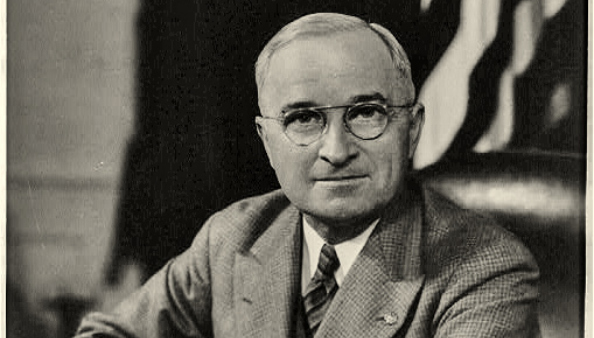
Harry Truman


Fear of Nazi Germany led to the development of the atomic bomb but with Berlin's surrender and bitter conflict continuing in the Pacific it seemed only natural to President Truman for him to order the use of this weapon in hopes of bringing the war with Japan to an end.  Japan's unconditional surrender following the destruction of Hiroshima and a second atomic attack on Nagasaki brought a rapid demobilization of American military forces.  Yet events quickly demonstrated that the perceived interests of the United States and those of the Soviet Union were in direct conflict.


Dean Acheson


Secretary of State Dean Acheson had not anticipated military action by Communist forces in North Korea when he placed South Korea outside America's vital interests.  Stalin, in turn, was surprised by the determined military response of the United States to developments on the Korean peninsula.  Both countries quickly learned it was dangerous to miscalculate the other.  The Korean War more than any other single event made clear a Cold War did exist between the globe's two emergent super powers.


Dwight Eisenhower


President Dwight Eisenhower, famed for overseeing the successful amphibious assault at Normandy in 1944, was determined to keep military costs to a minimum by relying on the threatened use of nuclear weapons in response to any military move on Western Europe by the Soviet Union's still large conventional army.  Nuclear bombs and the means of delivering them was vastly cheaper than maintaining armed divisions.  


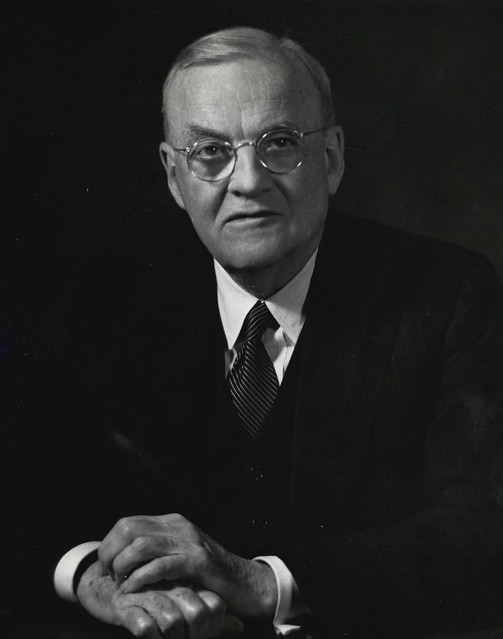
John Foster Dulles


The ardent anti-Communist John Foster Dulles, Secretary of State under Dwight Eisenhower, was a strenuous proponent of massive retaliation, believing that releasing unrestrained force was the best deterrence to aggression.  During the course of the 1950s Russia's own massive retaliatory power grew placing increased dependence on the credibility of America's nuclear threat.  Citizens of Berlin, for instance, could only wonder whether the United States government was willing to risk destruction of its own cities in defense of this German city isolated deep within the Communist block.  


Maxwell Taylor


General Maxwell Taylor, Army Chief of Staff under Eisenhower, called for a Strategy of Flexible Response.  His argument for an American military capable of handling threats with conventional weapons would require enormous increases in defense spending and his belief in funding the means to fight limited wars found a receptive ear only when John Kennedy entered the White House.  Within a couple of years President Kennedy introduced American troops into Southeast Asia and Maxwell Taylor would serve briefly as Ambassador to South Vietnam.      


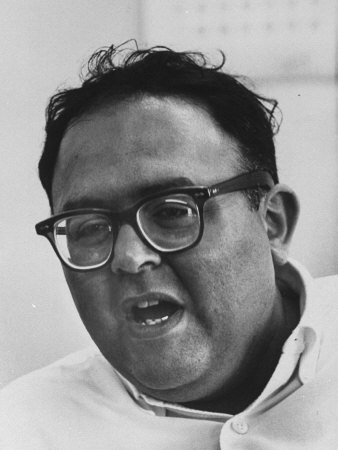
Herman Kahn


Herman Kahn made his reputation for speaking the unthinkable while employed at the RAND Corporation whose mission it was to freely explore the range of options available in thermonuclear war.  His detached approach to gaming the catastrophic made him the basis for the bizarre, mad character that was the centerpiece of the motion picture Dr. Strangelove.


John von Neumann


Oskar Morgenstern


Two less flamboyant colleagues of Herman Kahn at the RAND Corporation were the celebrated mathematicians John von Neumann and Oskar Morgenstern.   Their work in game theory led them to believe in the ultimate interdependence of the United States and the Soviet Union.  The two nation's fates were linked and the decision making of each would ultimately require keeping the interests of their potential enemy always in mind in order to prevent antagonisms from getting out of hand.  A practical application of this mindset occurred in the peaceful remedy to the Cuban Missile Crisis where each side avoided backing the other into a corner.


Henry Kissinger


This obscure Harvard professor gained national attention with the publication of his book, Nuclear Weapons and Foreign Policy, in which he argued that military means and diplomatic approaches are not separate ventures but interrelated when arbitrating differences between confrontational nations.  Kissinger would become a seminal adviser to Richard Nixon during a period of relative rapprochement between America and her Cold War adversaries China and the Soviet Union.