Showing posts with label Tupolev. Show all posts

Wednesday, December 28, 2011

Tu-16

Tu-16 Badger


Tupolev


Tu-16 Badger


Developed in the early 1950s the Tu-16 was the Soviet equivalent of the American B-47.  Its two large engines produced thrust equivalent to that generated by the six J47 engines on the Boeing.  It had a very good airframe and it was adapted beyond the bomber role over the years to include maritime reconnaissance and aerial tanker.  


Tu-16


Crew:                    6 - 7

Power:                  2 - Mikulin AM-3 M-500 turbojets, 9,320 kg / 21,000 lb thrust each

Max. Speed:        1,050 kph / 650 mph
Ceiling:                 12,800 m / 41,995 ft
Range:                  7,200 km / 4,474 miles
Climb:                   Not Available

Weight -
Empty:                 37,200 kg / 82,012 lb
Max. Take Off:    79,000 kg / 174,165 lb

Size - 
Wingspan:          33.50 m / 109 ft 11 in
Wing Area:         164.65 sq m / 1772 sq ft
Length:                36.5 m / 119 ft 9 in
Height:                 10.8 m / 35 ft 5 in

Armament:
                            6 - 23 mm / 0.91 in NR-23 cannons
                                  9800 kg / 21,605 lb nuclear or conventional ordnance


V I D E O


Stand Off Missile


Any hope the U.S. had of preventing Western Europe from being overrun by Warsaw Pact conventional forces required maintaining open sea lanes with North America.  The Tu-16 armed with the AS-6 'Kingfish' long-range nuclear missile threatened to knock out America's carrier battle groups in the Atlantic.  A scenario such as this would quickly lead to an exchange of ICBMs between the two warring super powers.  The resulting destruction of the two society's cities and industrial capacity rendered these actions suicidal.  The illustration is by Johan Franken.      
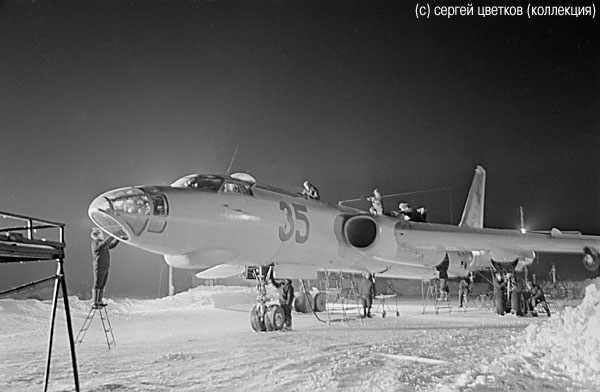


Subzero Maintenance


A freezing winter night and this Russian ground crew is doing what needs to be done.  When you hear talk of military readiness think of measures such as these.  Critical military assignments wouldn't be described as comfortable or convenient by those charged with carrying them out.  The photo above is from Air Force, Russia.  


Cat and Mouse


Always snoop, always test the readiness of the other side.  This would be a familiar sight during the Cold War.  The pods beneath the wings of this Tu-16 reveals its mission of ELINT - Electronic Intelligence gathering.  Additional reconnaissance capability is provided by the bubbles seen under the fuselage.  It may seem a bit unnerving to Navy ships but this Tu-16R isn't the lethal Tu-16K-10, armed with ship-killing missiles.  


Tu-16 flies over Soviet Typhoon Submarine


This Badger is flying over the very large Russian Typhoon Class missile-firing nuclear submarine.  These are the largest submarines ever made and they house 20 missiles.  The protrusion from the end of the Tu-16's wing is for aerial refueling - a unique wingtip to wingtip method of transferring fuel between a Tu-16N tanker and the Badger.  


Tu-16 crew member


A typical Badger crew consisted of pilot, co-pilot, navigator and flight engineer in the front crew compartment and a ventral and tail gunner in the rear compartment.  Reconnaissance Tu-16s may well have an addition two to three crew members dedicated to intelligence gathering.  The above Badger has an enlarged radome for improved search and target tracking.  


Diagram


The Tu-16 lasted twenty years beyond its contemporary, the B-47, because it proved to be a versatile platform.  It was designed to deliver the Soviet Union's largest nuclear weapon but its limited range prevented it from being a true strategic bomber.  Several Tu-16s were sold to Egypt over the years.  The initial group was mostly destroyed on the ground by Israeli pilots at the beginning of the 1967 Six-Day War.  The Tu-16 fared better in the 1973 Yom Kippur War as they were able to launch 25 missiles at Israeli targets.  


Chinese Hian H-6


China built the Tu-16 under license and is the only country known to continue operating this aircraft.  Besides Egypt, Iraq and Indonesia had also purchased the Badger for their air force.  The Tu-22 Blinder was the intended replacement for the Badger  but while it was faster its range was disappointing and production was limited.  Some of the Blinders would eventually be sold to Libya.  


Transition Aircraft


The Tupolev Badger was a swept wing bomber that retained World War II concepts with a tail gunner and both dorsal and ventral gun emplacements like those found on the B-29.  Germany's defeat in 1945 eliminated the need for cooperation between the wartime allies, Russia and the United States.  The rivalry between the two dominant powers extended beyond ideological differences.  The tension of the Cold War has abated but frictions will remain between the two nations as demonstrated by their competing interests with countries like Iran.  China has grown in global stature as has Western Europe.  The 21st Century has begun much like the first years of the 20th Century when newly powerful nations confronted established nations for greater access to economic resources and increased political influence.  It remains to be seen whether the upcoming jostling for dominance can be limited to peaceful competition. 


A V I A T I O N


OVER EASY


Monday, December 12, 2011

Tu-160

Tu-160 Blackjack


Tupolev


Tupolev Tu-160 Blackjack


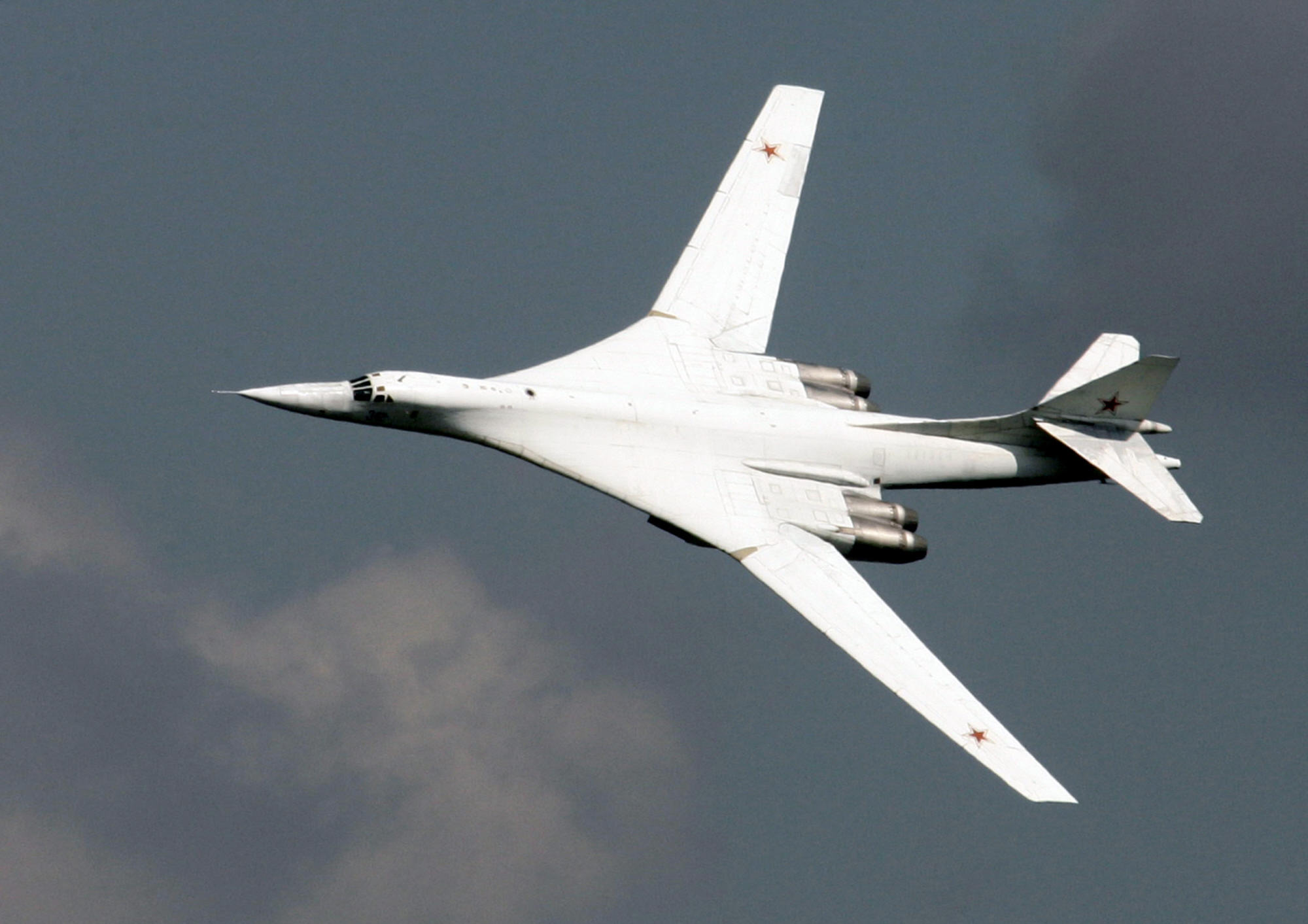
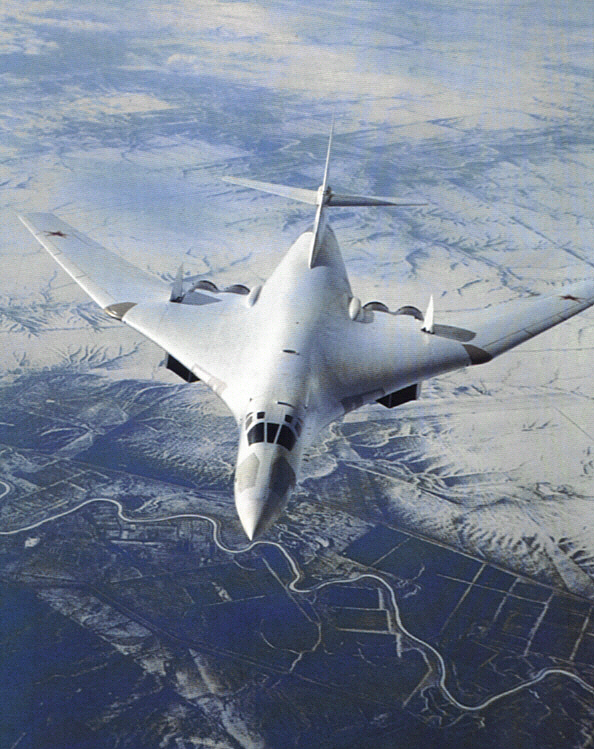
The Tu-160 is Russia's most modern strategic bomber.  It is the largest combat aircraft in existence today.  It is considerably faster than America's B-1 and it has greater range.  The original plan was to build 100 of these formidable bombers but production stopped at 36 with the signing of the Strategic Arms Limitation agreement with the United States.  


Tu-160


Crew:                    4 - pilot, co-pilot
                                  Weapons Systems Officer
                                  Defense System Operator

Power:                  4 - Kuznetsov 25,000 kg / 55,025 lb thrust NK-321 turbofans

Max. Speed:         2220 kph / 1378 mph
Ceiling:                 15,006 m / 49,235 ft
Range:                 12,300 km / 7638 miles
Climb:                   4203 m / 13,780 ft per minute

Weight -
Empty:                 110,000 kg / 242,110 lb
Max. Take Off:     275,000 kg / 605,275 lb

Size -
Wingspan:           55.7 m / 182 ft 9 in, unswept
Wing Area:          360 sq m / 3875 sq ft
Length:                54.1 m / 177 ft 6 in
Height:                13.1 m / 43 ft

Armament:
                          up to 16,500 kg / 36,316 lb of ordinance
                          including:
                          6 - Kh-55 long-range missiles or
                          12 - Kh-15 short-range missiles or
                          free fall nuclear or conventional weapons


V I D E O


Cockpit


All four crew members of the Tu-160 have ejection seats.  For long flights there is a crew rest area, toilet and a galley.  The pilots use fighter-type control sticks but the original aircraft came with steam gauges - the familiar analog dials as opposed to CRT screens.  Plans were made in 2003 to modernize the Blackjack with a new digital flight control system.  


Wings extended.


The variable-geometry wings of the Tu-160 can be manually set in one of three positions:  20 degrees for take-offs and landings, 35 degrees at cruise speed and 65 degrees for high speed flight.  For cost cutting reasons the B-1B was designed for low-level subsonic flight in order to penetrate enemy defenses.  The more expensive Tu-160 is capable of both low level subsonic and high-level Mach 1.9 penetration to its target.  Leaders subsequent to the Soviet regime have determined the craft too costly to maintain and there may be no more than 16 of these bombers in service today.  


Fighter Escort


The fall of the Soviet Union left 19 Tu-160s in the hands of the Ukrainians.  Attempts by Russia to buy back the bombers fell through in 1997.  Further upsetting to Russia was the decision by Ukraine to allow American intelligence officials to inspect one of the bombers.  These Ukrainian aircraft were eventually scrapped under the terms of the Strategic Arms Reduction Treaty.  


Swept wing at 35 degrees.


One of the problems with the Tupolev Tu 160 program was that aircraft were being delivered before there was an agreed upon common standard for configuration.  Basic specifications differ somewhat from aircraft to aircraft adding to maintenance complexity.  


A V I A T I O N


OVER EASY


Tuesday, November 22, 2011

Tu-95

Tu-95 Bear

Tupolev


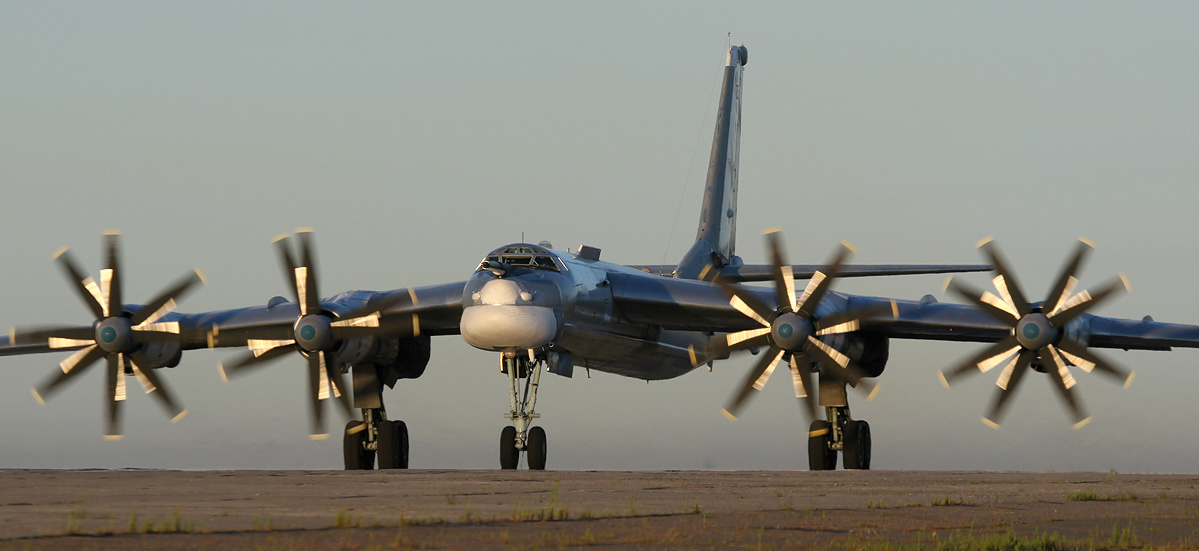
Tupolev Tu-95 taxis across runway.


Crew:                    6 - 7

Power:                   4 - KKBM Kuznetsov NK-12MV Turboprops
                                    15,000 eshp each

Max. Speed:           828 kph / 514 mph
Ceiling:                   12,500 m / 41,010 ft
Range:                   12,800 km / 7,949 miles
Climb:                     not available

Weight -
Empty:                   90,000 kg / 198,090 lb
Max. Take Off:      188,000 kg / 413,788 lb

Size -
Wingspan:             51.1 m / 167 ft 8 in
Wing Area:            297 sq m / 3,197 sq ft
Length:                  49.5 m / 162 ft 5 in
Height:                  12.12 m / 39 ft 9 in

Armament:
                             2 - 23 mm / 0.9 in cannon in tail, radar controlled
                             16 - Kh-55 "Kent" cruise missiles in bomb bay, under wings


Tu-95 video


Tu-95 prop strategic bomber


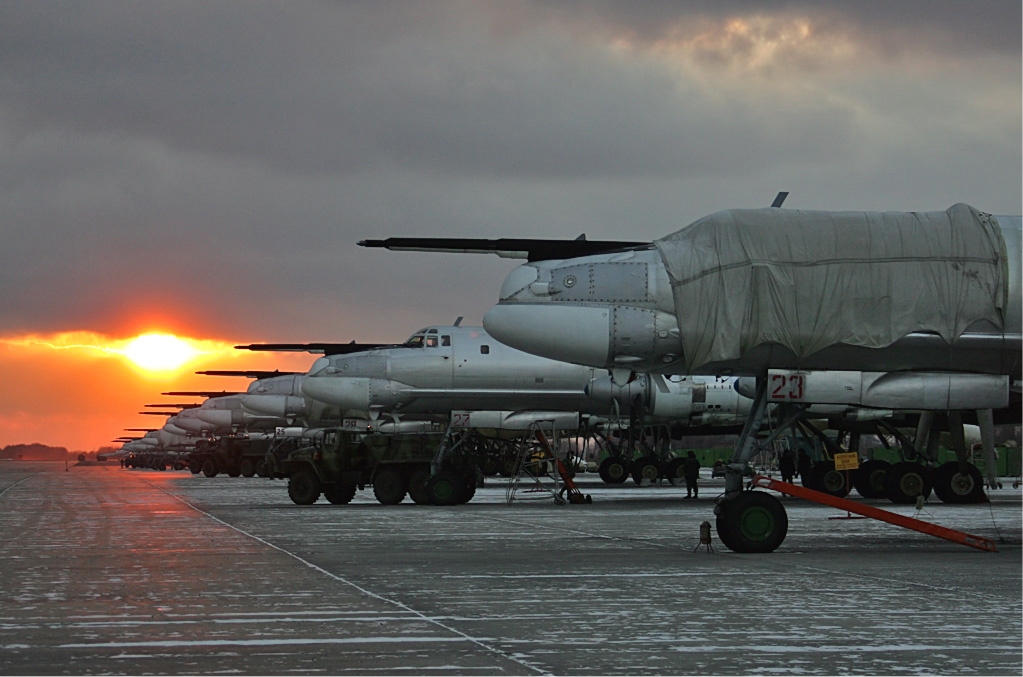
Tu-95 flight line at Engels Air Force Base 


Related Topics:

Vulcan


OVER EASY