Showing posts with label Vought. Show all posts

Thursday, November 28, 2013

F7U Cutlass

F7U Cutlass

F7U with Sparrow I AAMs

First Flight:                          1948, September 29
Type:                                     single-seat carrier-based fighter
Power:                                
         J46-WE-8A, Westinghouse (2)
         2767kg / 6100lb afterburning thrust
Armament:
                                             20mm / 0.78in cannon
                                             Sparrow AAMs (4) - underwing attachments
Size:
                Wingspan -         12.09m / 39ft 8in
                                             38o swept wing
                Length -               13.13m / 43ft 1in
                Height -               4.46m / 14ft 7.5in
                Wing Area -        46.08m2 / 496ft2
Weight:
                Empty -                8260kg / 18,210lb
                Max Take-off -   14,353kg / 31,642lb
Performance:
                Max Speed -        1094kph / 680mph
                Landing Speed    220kph / 136mph
                Ceiling -                12,190m / 40,000ft
                Range -                 1062km / 660 miles
                Climb -                  3960m / 13,000fpm
Production:                           290 F7U-3 built; introduced in 1951

Radical design featured no tail

The world’s first operational fighter, the German Me 262, brought an end to propeller-driven combat aviation for most air force planners.  From here on out the future would be jets.  In 1945 the US Navy issued a requirement that the next generation of carrier-borne fighters would be capable of speeds of 600 mph.  Chance-Vought won the contract competition with a revolutionary new design.  The F7U would be a tailless aircraft with twin jet engines in its fuselage that would feature afterburners to give it additional bursts of power.  After a long period of development, this aircraft would eventually equip 13 Navy and Marine squadrons.  Yet three years after reaching the fleet in 1954, the F7U-3 Cutlass was withdrawn from service.

F7U pilots suffered many fatal accidents

The aircraft was an ambitious design.  It had gone beyond cutting-edge and strayed into bleeding-edge technology.  The initial Westinghouse engines were disappointing, leaving the aircraft underpowered.  Its radical design enabled it to achieve a tight turning radius but, overall, it was difficult to fly.  The F7U was overly complicated a challenge to maintain.  Engineers eventually added more than 100 doors and access panels to its design.  The twin engines took up most of the available room in the fuselage, leaving little to spare for fuel.  This resulted in a carrier plane with insufficient range for ship-board operations.  This also meant that fuel-guzzling afterburners were of little use.

Extended nosewheel made landing difficult

The tricycle landing gear, featuring a drastically extended nosewheel, contributed to the danger in carrier landings.  The nose of the aircraft was redesigned repeatedly to improve pilot visibility but the problem remained unsolved.  A 25% accident rate added considerably to pilots’ unhappiness with the Navy jet.  Once the safer, more reliable and powerful F-8 Crusader became available to the fleet, the F7U was gratefully withdrawn.  The aircraft was not a success but its experience aided the research in developing future jets for the Navy, such as the F-14 Tomcat.

Reconnaissance version of F7U

Wednesday, January 18, 2012

F4U

F4U Corsair
Vought
C L I C K     T O     E N L A R G E


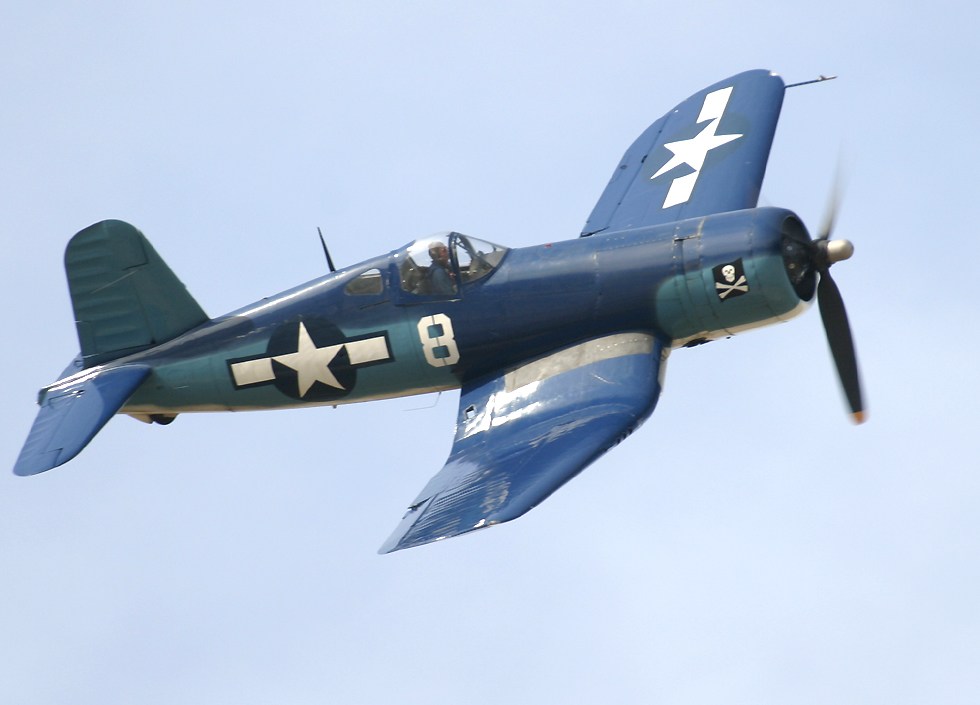
Building a carrier fighter around the largest piston engine available determined the look of the F4U Corsair.  The propeller was over 4 meters, 13 feet 6 inches, in diameter, requiring long landing struts.  But carrier landings are too harsh for relatively spindly landing gear so the wings were bent into an inverted gull wing, shortening the length needed for wing mounted struts.  Keeping the plane as small as possible meant cramming the engine, turbocharger and a fuel tank in front of the pilot making for a nose extending over 4 meters, 14 feet, beyond the cockpit.  
Picture:  980 x 705 - Richard Seaman


Crew:                    1

Power:                  Pratt & Whitney 2000 hp R-2800-8 18-cylinder
                              Double Wasp two-row air-cooled radial engine

Max. Speed:        671 kph / 417 mph
Ceiling:                 11,247 m / 36,900 ft
Range:                  1633 km / 1015 miles
Climb:                   951 m / 3120 ft per minute

Weight -
Empty:                 4074 kg / 8982 lb
Max. Take Off:    6350 kg / 14,000 lb

Size -
Wingspan:         12.5 m / 41 ft
Wing Area:        29.17 sq m / 314 sq ft

Armament:
                           6 - 12.7 mm / 0.5 in machine guns w/2350 rounds total or
                           4 - M2 Cannon (C model)


Within the base of the wing are vents leading to plane's supercharger which diverts the engine's exhaust into turbines that compress air through high speed revolutions.  The compressed air is mixed with fuel and forced into the carburetor ensuring the engine gets the same amount of air at high altitude that it would at sea level.  
Picture:  679 x 338 - Photo Net 


The initial several hundred Corsairs went to the Marines because they failed their initial carrier suitability tests.  The F4U had a dangerous tendency to bounce when landing on the carrier's deck and the long nose obstructed the pilot's forward view trying to land.  The pilot's position was raised up and landing characteristics were improved and although the Navy eventually accepted the F4U for carrier duty they were already quite happy with the F6F Hellcat in the fighter role.  
Picture:  595 x 603 at 96 dpi - Damage Inc


The Marines preferred the F4U in the Pacific as it had both speed and agility.  It was the first American aircraft that was more than a match for the Japanese Zero.  It had an overall 11:1 kill ratio over opposing aircraft during World War II.  Later models were fitted with wing pylons for the ground attack role in the Pacific island hopping campaign.  It was widely depended upon in this role later in Korea and by the French against the Viet Minh in the 1950s.
Picture:  900 x 704 at 96 dpi - Damage Inc


The unusual sound made by the F4U in its attack approach led to the nickname Whistling Death given it by Japanese troops.  Besides rockets it could also mount several hundred pounds of bombs beneath each wing.  Intended by the Navy as their fighter it proved a better fit with the Marines and they converted all their squadrons to it within six months of its introduction.
Picture:  1024 x 768 - Reddit


Designing an aircraft to go up against the best of the best in a life or death encounter is never routine.  The specifications to be met challenge available technology and drawing board solutions never anticipate all the eventual problems faced in harsh reality.  Remedies can be stubbornly elusive adding months to development time.  Many designs simply fail and their expensive prototypes are discarded.  Marine ace Major Gregory "Pappy" Boyington gained fame downing Zeros using the F4U but the Corsair's chief designer Rex Beisel deserves a couple columns of print, as well.
Picture:  1280 x 1024 - Warbird Depot


Wednesday, December 21, 2011

F-8

F-8 Crusader


Vought


F-8 Crusader


The F-8 is the result of Navy specifications in 1952 for a supersonic carrier based fighter to provide fleet defense.  It first flew in 1955 and with its Pratt & Whitney J57 engine it was soon able to attain speeds over 1600 kph / 1000 mph.  It was the last American fighter whose primary armament was cannons and not missiles.  


F - 8E


Crew:                    1

Power:                   1 - Pratt & Whitney 8165 kg / 18,000 lb afterburning thrust J57-P-20A turbojet engine

Max. Speed:          1800 kph / 1120 mph
Ceiling:                   17,983 m / 59,000 ft
Range:                    966 km / 600 miles
Climb:                    17,374 m / 57,000 ft in 6 minutes

Weight -
Empty:                   9038 kg / 19,925 lb
Max. Take Off:     15,422 kg / 34,000 lb

Size -
Wingspan:             10.72 m / 35 ft 2 in
Wing Area:            32.52 sq m / 350 sq ft
Length:                  16.61 m / 54 ft 6 in
Height:                   4.8 m / 15 ft 9 in

Armament:
                            4 - 20 mm / 0.78 in cannon
                            4 - AIM-9 Sidewinder air-to-air missiles or
                            2 - AGM-12B Bullpup missiles 


V I D E O 


Carrier Launch


The stress of carrier operations on aircraft means stronger airframes, more robust landing gear, additional equipment and greater fuel capacity.  The additional weight alone compromises performance so it is unusual to have a jet designed for the Navy outperform its Air Force counterparts.  As a fighter the F-8 compares very favorably with the F-100 and the F-105 although the Thud 105 was a workhorse in the ground attack role as well, something the Crusader could do in a limited capacity.  


USS Midway


Older Essex Class carriers retained the F-8 for fleet defense even after its replacement, the F-4 Phantom, came into service because the Phantom's greater size and weight wasn't compatible for smaller carriers.  Moving from single engine jets to those with two engines certainly added weight and fuel consumption but it also ensured that the flame out of one engine did not necessarily result in an expensive jet and pilot being lost in the drink.  The new F-35 returns to a single engine but, presumably, they will prove more reliable than engines powering the early years of jet aviation.  


Variable-incidence Wing


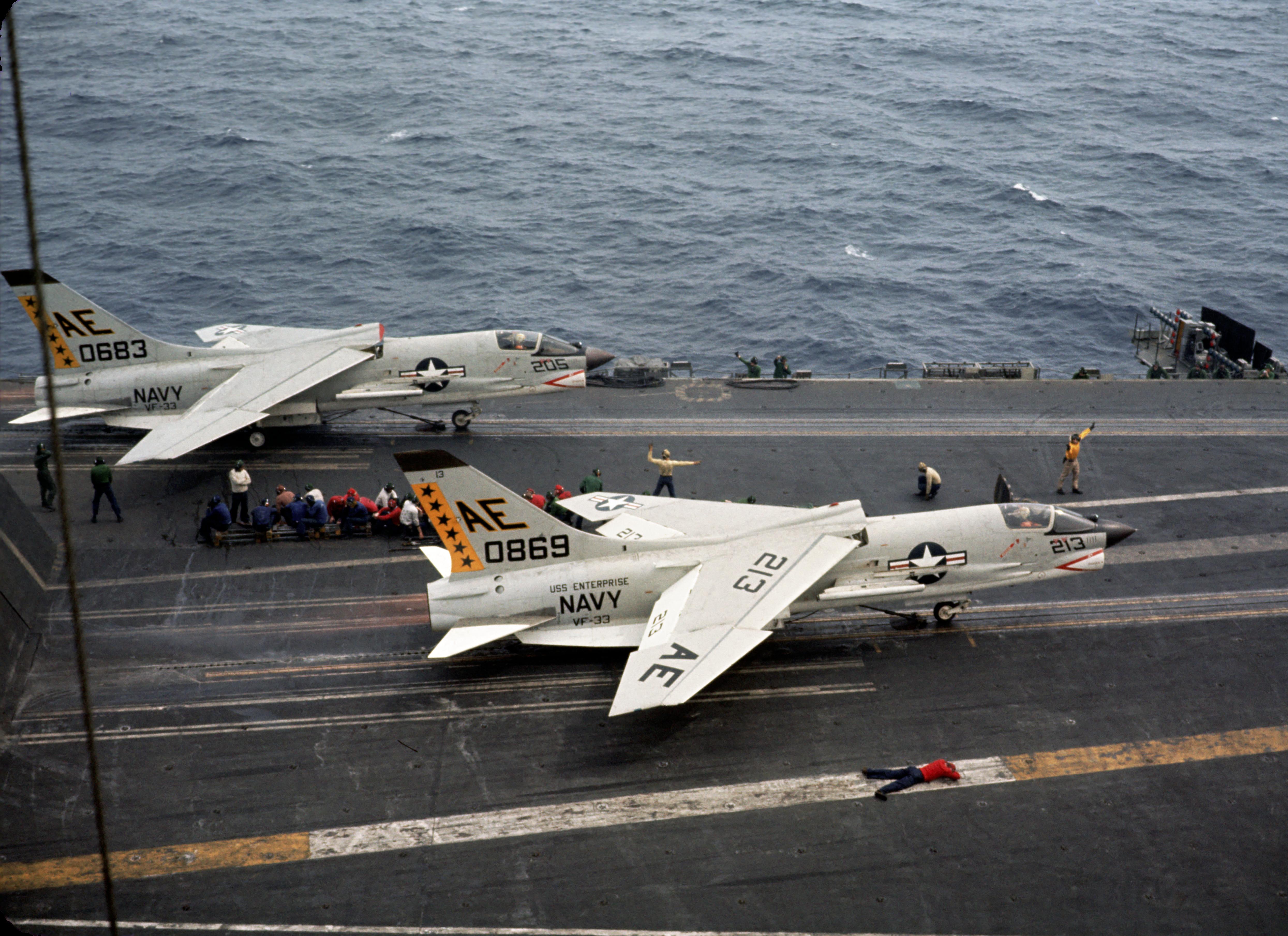
Unique to the F-8 is the wing's ability to pivot up on both take off and landing in order to increase the plane's lift when it needs to be airborne quickly and slowing its rate of approach when landing.  The angled wing also enables the fuselage to remain relatively level, providing the pilot a better view of the carrier deck.  Despite this the jet remained difficult to land because of its speed instability.  


Ejection Seat


You did not need to be shot down over North Vietnam to find the ejection seat a life saver.  Over 500 of the 1200 F-8s built were lost to accident.  Riding cutting edge technology at blinding speed is always risky business.  


Last Resort


This F-8 pilot has been abruptly transferred to a secondary, less acceptable, means of conveyance.  Ejection is not a simple matter.  Everything must work as designed - the canopy separates from the craft, the seat ejects properly, your limbs strike nothing on the way out, you separate from the seat and the chute deploys in a satisfactory manner.  In most instances you'd probably prefer being over land, as well.  


Instrument Panel


There's a lot here to learn until it becomes second nature.  But in a close in dogfight there is no time to survey the numbers.  Your head is swiveling constantly about, your struggling with g forces that increase your body weight to 7, 8 and 9 times normal.  Who sees who first often determines who finds themself stuck in flaming wreckage hurtling toward earth.  The F-8 scores high marks on agility but its pilot relied on his wingman to provide the eyes for his blind backside.  


Tu-95 Escort


This F-8 was scrambled from the USS Oriskany, seen below, to accompany the Tu-95 Bear beyond its reconnaissance target.  Each side was always in the act of probing, testing and spying on the other throughout the duration of the Cold War.  An entire generation has grown up without appreciating the significance of two nuclear superpowers always poised face to face, toe to toe, each determined never to flinch.  


A V I A T I O N


OVER EASY