Showing posts with label notochord. Show all posts

Tuesday, March 18, 2014

Notochord


Lamprey notochord and vacuolated core cells

The notochord, a slender elastic-like rod, is one of four biological features that draw together a wide range of animals into a single grouping named Chordata.  Along with the notochord, the dorsal nerve cord, pharyngeal slits and postanal tail are characteristics shared by an assemblage that includes both humans and the sac-like sea squirt.  Vertebrates make up the vast majority of the animals represented but the larval form of the marine sea squirt gives them admission to this distinguished club, as well. 

45 hour old chick embryo with notochord

The notochord is a hydrostatic organ with a tough outer wall enclosing a fluid core.  This gives it lateral elasticity while enabling it to resist any axial compression.  Anchored to this rod, that extends nearly the length of the organism, is a series of segmented muscles used, in most instances, to give the animal the means of propulsion through the water.  The contraction of muscles on one side and then to the next provides alternating lateral pressure against the surrounding substrate.  The resulting undulating motion propels the animal forward.  Once the muscles relax after contracting on one side of the body the springy notochord acts to straighten the body out.  The notochord acts as the antagonist against the muscles’ action, enhancing the sweeping of the tail from side to side. 
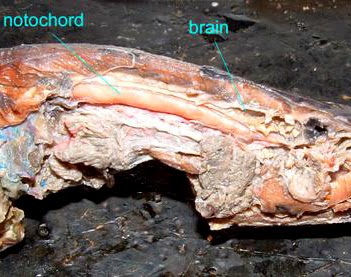
Lamprey notochord extending beneath brain

The hydrostatic nature of the notochord prevents the compression of the animal’s axis which would severely hinder its ability to swim.  This pressure is provided by fluid residing between the notochord’s core cells or by core cells swollen with vacuoles containing fluid.  These vacuolated cells are wrapped tight within a sheath of tough, fibrous tissue.  Under these conditions the inner fluid is held fixed, unable to flow. 

Zebrafish embryo with notochord, segmented muscles

The notochord may persist in more primitive chordates but in the case of bony fish and terrestrial vertebrates this rod is replaced by the vertebral column.  In these instances the notochord appears as a structure used as a scaffold around which the embryonic body can grow.  It makes its appearance early when the mesodermal layers at the dorsal midline differentiates into the chordamesoderm tissue.  This gives rise to the notochord as well as further stimulating the differentiation of the overlying ectoderm into producing the central nervous system.   It is consequently above the body’s main central cavity, or coelom, and beneath the dorsal nerve cord.

Human vertebrae with notochord derived discs

The notochord does not necessarily disappear.  In adult mammals it has transformed into a series of intervertebral disks.  These form circular pads that lie between the successive vertebrae.  Each pad is a fibrocartilage tissue that encloses a gel-like core, called the nucleus pulposus, providing a cushion between the connected bony vertebrae.  If you’ve ever suffered a slipped, ruptured or crushed disc you know how important these structures can be to your general well-being and a healthy frame of mind.


Monday, March 10, 2014

Chordata: Link to Invertebrates


Tunicate larva and tadpole

The major grouping of animals, or phylum, known as Chordata is of particular interest because it contains all vertebrate animals (subphylum Vertebrata) as well as provides a historic relationship with a number of organisms, like starfish, that show no identifiable similarities with mammals seen in the zoo.  What ancestor we have in common with this invertebrate would have to go back many millions of years.  Starfish belong to the phylum Echinodermata.  This grouping is made up of sea urchins, sea cucumbers and other marine animals in addition to the starfish.  Their link to us probably goes back well over five hundred million years, to the early Paleozoic era – near the beginning of fossils that have been discovered with the unaided eye. 

There is no clue about vertebrate origins when you examine an adult echinoderm.  Their morphology lacks any of the characteristics we associate with modern vertebrates – such as a brain and an internal skeleton.  The relationship with vertebrate ancestors is found in the larval stage of animals similar to these.  The larva of the sea squirt, the tunicates, has some of the hallmark characteristics found in Chordates – ancestors to the vertebrates.  These include a notochord (which serves as a backbone), a dorsal nerve cord and segmented muscles – all characteristics found in today’s vertebrate animals. 

Adult sea squirts

How juvenile traits are retained by adult descendants is explained by the process called paedomorphosis.  For chordates to descend from the larval form of some ancestral echinoderm would require the larva’s reproductive organs to mature prior to reaching the adult stage.  Descendants of this process might retain these larval characteristics into adulthood if they prove beneficial to the animal’s survival. 

The notochord is a flexible, rodlike structure that extends the length of the body providing the animal an axis for muscle attachment and giving the animal the undulating movement needed for propulsion through water.   For vertebrates the notochord appears during embryonic development and becomes the basis for the vertebrae. 

The dorsal nerve cord enables the development of a central nervous system and the enlargement of the anterior end into what becomes the organism’s brain.  This allows for a more sophisticated body plan based on greater awareness of one’s surroundings and the means to quickly move to more suitable locations and to pursue prey. 

Segmented musculature controlled by a centralized nervous system improves coordination and to enable a response time rapid enough to effectively pursue prey or to avoid the lunge of a predator.  These elements, found in the ancient fossils of the first chordates, are elaborated upon over time to include a postanal tail – a muscular appendage extending beyond the anus that significantly improves the animal’s means of propulsion.

The earliest chordates undoubtedly had pharyngeal pouches that were perforated and would be used for filter feeding.  These slits enabling water to pass through would later be the basis for respiration, gills that enabled the exchange of gases between the animal and the water.  Embryonic pharyngeal pouches give rise to the Eustachian tube, the middle ear and other devices in land-based vertebrates. 

X-Ray Tetra reveals vertebra

Other chordate characteristics that would be increasingly elaborated upon over time would include an endoskeleton, paired appendages, a complete digestive tract and a ventral heart with a closed blood system to go with it.  The body plan worked because it proved to be extremely adaptable and the resulting vertebrates were able to widely diversify in form and function to fit the demands of most of the world’s habitats.