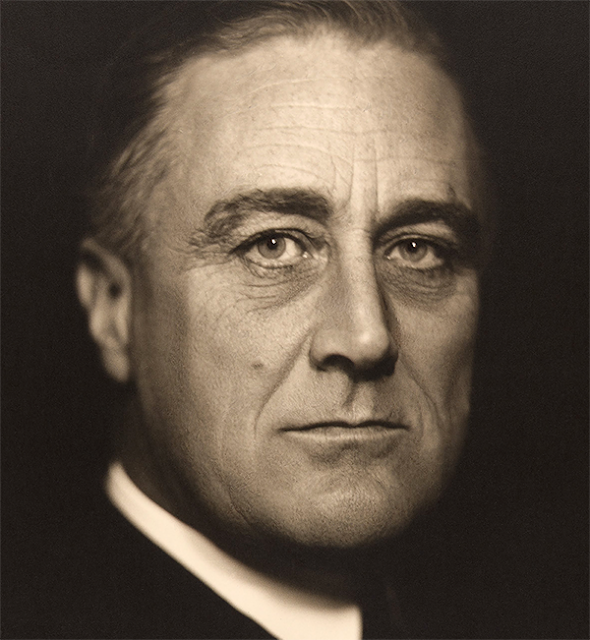
FDR
"What is clearer than that the framers meant the President
to be the chief executive in peace and in war the
commander in chief?"
Franklin Roosevelt (3 - p. ix)
Lend-Lease Bill Extends Wide
Powers of President
16 February, 1941
NY TIMES
The difficult passage of Roosevelt's Lend-Lease Bill through Congress
prevents him from meeting with Prime Minister Churchill before the
summer of 1941.
Lend-Lease:
* provides munitions, aircraft and weapons to Britain on credit
* General Arnold, U.S. Army Air Corps commander protested sale of planes
* Arnold argued the planes are needed for America's own security
* Roosevelt would have none of it. Looking at Arnold he said:
" There are places to which officers who do not 'play ball' might
be sent - such as Guam." (3 - p. 14)
Threat:
Tripartite Pact - coalition of three military empires:
Hitler - Third Reich / Blitzkrieg
Mussolini - Italian Empire / inept leadership
Tojo - Empire of Japan / amphibious invasions
Roosevelt believes:
* war inevitable and pushes Congress to expand Armed Forces
* Churchill is the political leader of a fading colonial power
* Roosevelt feels it imperative to protect Britain but
not Britain's Empire
Roosevelt assessment of his military chiefs of staff:
* little to no faith in their military or political judgment
* Respect them as service chiefs but subordinate to his judgment
* Generals and Admirals may lack necessary initiative and drive
* Roosevelt willing to set aggressive goals - take risks
* Roosevelt's national strategy reflected political realities
(1 - p. 2)
* War Department assessments counter to Roosevelt opinion:
* Germany would conquer Russia in a few weeks
* Roosevelt: Russia shows stiff resistance - added to
Lend-Lease
* Britain should abandon their position in North Africa
* Roosevelt: Mediterranean good starting point for
confronting Nazis / Suez and oil worth
protecting
* U.S. Atlantic Fleet should have precedence over Pacific concerns
* Roosevelt: Pacific Fleet must provide counter to Japan
* U.S. forces should assault Nazi-held Europe in 1942
* Roosevelt: Suicide - North Africa is more appropriate
objective for green American troops facing the
Wehrmacht for first time (3 - p. 8)
Wehrmacht - German armed forces
U-Boats Roam Sea
with a New Fury
7 October 1941
NY TIMES
Battle of Britain
* Hitler convinced England too strong to invade
* Britain's Royal Navy would prevent amphibious Channel assault
* Royal Air Force maintains tenuous control of the air
* Britain has world's most powerful navy to protect its sea lanes
* Island nation almost entirely dependent on seaborne commerce
* British vulnerable to sea blockade
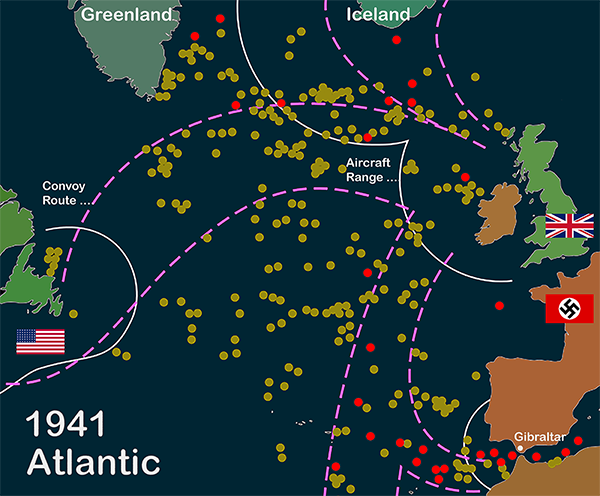
* Germany turns to submarines, its U-boats
* submarines sink enough commerce and Britain loses the war
* Britain's survival key to Germany's defeat (5 - p. 205)
Battle of the Atlantic
* Allies' first priority was victory in the Battle of the Atlantic
* U-boat: unterseeboot - under-sea-boat
* able to approach surface target undetected
* high-explosive torpedo blows open ship's side
* slow, limited underwater endurance
* limited battery endurance submarine's biggest weakness
* run diesel engines on surface to recharge batteries
after only several hours underwater
* speed underwater 7 knots versus 17 knots on surface
* cramped, uncomfortable
* crew of 50
ASW - Anti-submarine Warfare
* Convoy merchant ships - grouping ships for mutual protection
* defended by escorting destroyers armed with depth charges
* convoy system improves chance of survival
* Conforming to group movement wastes time, increases effort
* ships sit in harbor waiting for convoy to assemble
* arriving all together creates congestion at destination port
* vigilance required to prevent merchant ships from colliding
* Submarines vulnerable to aircraft
* speed and range of aircraft cover larger areas of patrol
than ships
* most of Atlantic out of range of land-based aircraft
Roosevelt's Undeclared War
* Roosevelt provides U.S. Navy escorts to protect British convoys
* U.S. policy violates international rules on neutrality
* Roosevelt takes advantage of Hitler's fear of war with the U.S.
* By September 1941 U.S. destroyers and German submarines
are in open conflict
* U.S.S. Reuben James sunk by German torpedo (5 - p. 214)
Kiev Mopped Up
Nazis Announce
21 September 1941
NY TIMES
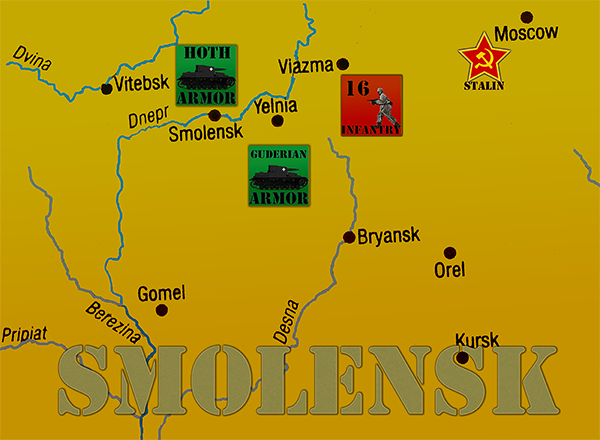
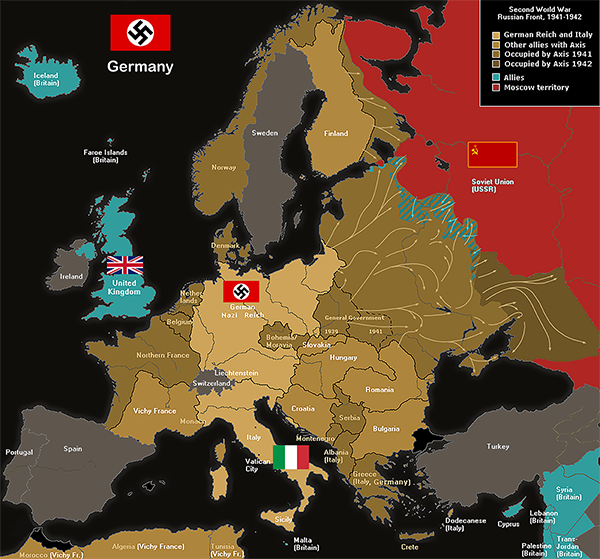
Barbarossa - invasion of Russia: 22 June 1940
* Shifting objectives due to dispute between Hitler and his generals
* Everyone believed the Soviet Army would quickly collapse
* making strategic goals unnecessary
* Wehrmacht Generals wanted an armored drive to Moscow
* Germany must have the war won by winter
* Germany wins using its advantages of armor:
* mobility
* tactics
* Germany loses when drawn into war of attrition
* Third Reich loses in a war of resources with Russia
* Hitler identified three strategic objectives to achieve before winter:
* Leningrad - uncertain as to reason
* Moscow - the heart of Soviet Union
* Kiev - Ukraine: vast natural resources including access to oil
* 60% of Russia's coal
* 30% of Russia's iron
* 70% of Russia's oil - Caspian Sea
* concentration of nation's industry - Donets River
* comparable to Ruhr industrial area of Germany
* Hitler's goals resulted in an unwinnable dispersion of forces
* Only Hitler's army headed toward Moscow had the armor
needed to achieve its goals
* Hitler diverted even this armor to aid his forces
in battles around Kiev and Leningrad
* Moscow and Leningrad would never be taken
* Hitler never took control of Ukrainian resources
(5 - p. 116)
Roosevelt thought Hitler's preoccupation with Russia provided
the Allies with opportunities to win contests against Nazi forces
in both the Atlantic and the Mediterranean Sea / North Africa.
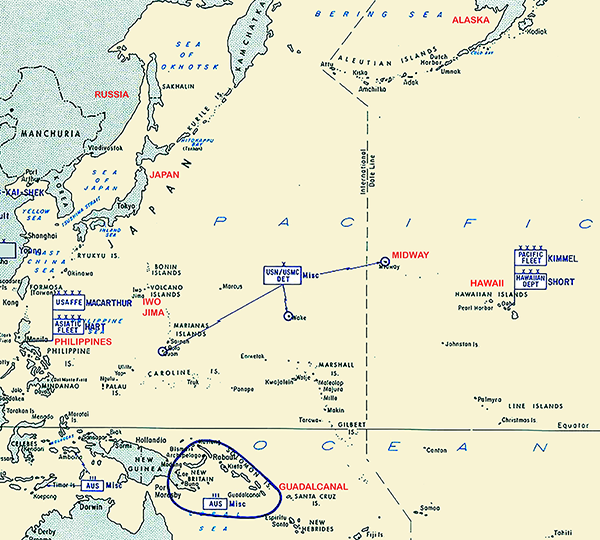
MacArthur Made Chief in Far East
27 July 1941
NY TIMES
American interests in Asia were based upon trade and its protection.
United States obtains Navy bases throughout the Pacific to defend sea lanes
* used as coaling stations and anchorages
* Midway, Alaska - 1867
* Hawaii, Philippines - 1898
* Samoa - 1900
With the outbreak of war in 1914 Japan captures German islands in Pacific:
* Marianas
* Saipan
* Carolines
* Truk
* Marshals
* Tarawa
* Japan fortified these islands as relations with the U.S. deteriorated
* this chain of militarized islands crossing all sea lanes to the
Far East made U.S. defense of its Philippines possession
extremely difficult if not impossible
* better having the American fleet sunk at Pearl Harbor
where ships were salvageable as opposed to being lost
to the depths of the Pacific thousands of miles away
24 July 1941 Japan militarily occupies French Indochina
* Germany's defeat of France makes the region a colonial orphan
* Japan's control of Hanoi cuts major supply line to hostile
China
* Roosevelt responds with an executive order:
* freezing Japanese assets in the United States
* restricting oil exports to Japan
* Japan has 18 months of oil reserve
* placing an economic blockade on Japan
* Japan faces financial paralysis
* U.S. insists Japan's aggression in China must end
* No Japanese government would survive accepting
these U.S. demands
October 1941 General Hideki Tojo takes command of Tokyo government
* Japan plans for:
* destruction of American fleet at Pearl Harbor
* expelling all white colonialist from the Far East (4 - p. 7)
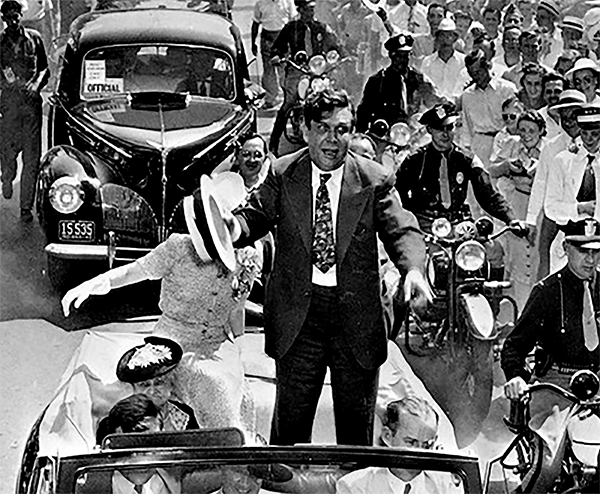
Republicans Nominate Wendell Willkie
for the Presidency
28 June 1940
NY TIMES
Wendell Willkie, 48 years / Republican / winning personality / former Democrat
* Never held elective office
* supports Roosevelt's aid to Britain
* Willkie's general domestic and foreign policies remain unclear
Franklin Roosevelt, 58 years / Democrat / running for unprecedented 3rd term
* health issues / high blood pressure / heavy smoker
* dumps his conservative vice president, John Garner, for
Henry Wallace
* Roosevelt focus during campaign was on passing 2 defense measures:
* providing Britain with World War I destroyers
* passing a draft law to expand the U.S. Army
* bill limited service to 1 year
* draftees could not leave Western Hemisphere
* Willkie endorsed bill as important for national security
August 1940 - Gallup Poll: 66% Americans favor drafting men 20 to 31 years.
September 1940 - Gallup Poll: 52% Americans believe helping Britain win war
more important that staying out of the fighting
October 1940 - Gallup Poll: Roosevelt leads Willkie 56% to 44%
When asked their preference were there no war in Europe
then voters preferred Willkie over Roosevelt 53% to 47%
The issues of war and peace were a clear advantage for Roosevelt as voters
wanted a president experienced in handling foreign affairs. (2 - p. 396)
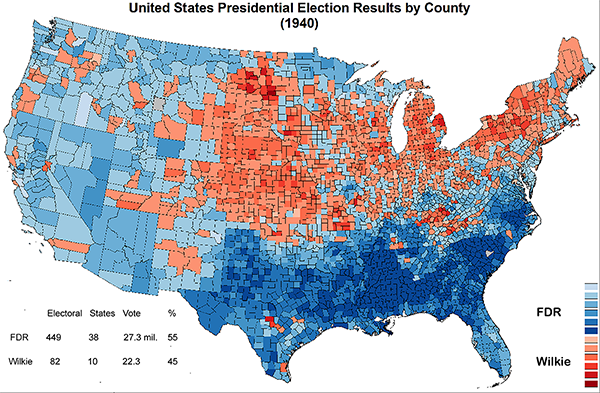
Roosevelt Elected President
6 November 1940
NY TIMES
Election night gave Roosevelt his win but he remained
wary of the nation's isolationist sentiments that persisted
as a potent political force until the morning of 7 December
1941. Suddenly one Sunday, Americans find they've been
soundly beaten in the Pacific by a force that appeared
from nowhere. Japanese forces seemed to be attacking
everywhere simultaneously, and winning - Malaysia,
Hong Kong, Java, the Philippines, New Guinea.
In short order, Hitler declares war on the U.S.
Roosevelt wanted this job, commander-in-chief,
despite his fears of what lie ahead. Now
it was left to him to bring together a war-winning
grand alliance of a Bolshevik, an Imperialist and
an elitist who saw himself born to be president.
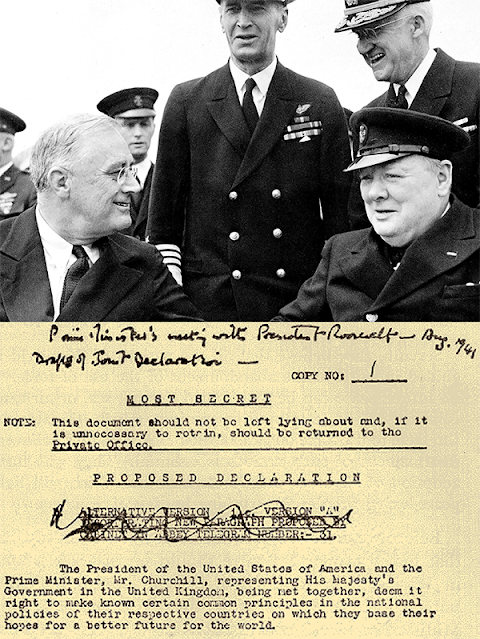
Wide Acclaim Here
for 'Eight Points'
15 August 1941
NY TIMES
9 August 1941 / Placentia Bay: historic meeting - Roosevelt and Churchill
* Atlantic Charter
* January 1941 - Harry Hopkins proposes to Churchill a meeting
with Roosevelt "to talk over the problem of the defeat of
Germany" - Roosevelt's words. (3 - p. 3)
* Roosevelt uses opportunity to declare his postwar global vision
* based on his Four Freedoms:
Freedom of Speech
Freedom of Worship
Freedom from Want
Freedom from Fear (3 - p. 16)
* Roosevelt hopes a peace communique will quiet isolationists'
fears / dealing with domestic political realities
* Roosevelt wanted to project strength to Germany and Japan
attempting to mask his country's unpreparedness for war
* He needed to buy time to deal with Hitler, Tojo and
Churchill - all while placating Congress and the public
* Placentia Bay - protected gulf off Newfoundland coast, Canada
* Naval station at Argentia ceded to United States by British
in a quid pro quo deal of U.S. destroyers in exchange
for British bases.
* one of 8 bases acquired for 50 destroyers (WWI vintage)
* Majority of American voters oppose being drawn into European war
* Public and Congress suspicious of Roosevelt-Churchill meeting
* In 1940 Presidential campaign Roosevelt assures voters:
there is no secret agenda "to involve this nation in any war"
(3 - p. 5)
* Roosevelt has secretly corresponded with Churchill since Poland
was invaded in 1939
* U.S. Ambassador to London Joseph P. Kennedy left in the dark
* Kennedy was an isolationist and an appeaser / not trusted
U.S. military chiefs brought to Placentia Bay:
Marshall, George C. - General, Army Chief of Staff
* stern
complaint: * Roosevelt makes all major military decisions
* Roosevelt does not allow Marshall to contest his decisions
Roosevelt: * Political leaders deferring to the military permitted
senseless battles of attrition in World War I
* will not delegate world war to the "professionals"
(3 - p. x)
* asserts his Constitutional authority as commander
-in-chief
Arnold, Henry "Hap" - General, Army Air Corps Chief
Stark, Harold R. "Betty" - Admiral, Chief of Naval Operations
King, Ernest "Ernie" - Admiral, Atlantic Fleet Commander (3 - p. 6)
Hopkins, Harry - Roosevelt's trusted personal emissary to:
* Churchill in London
* Stalin in Moscow
Churchill, Winston - Prime Minister, Britain
* resolute resister of Nazi tyranny
* 19th Century Imperialist - defender of British Empire
* Roosevelt promotes post-imperial view of global relations
* US supplants United Kingdom as guardian of world's democracies (3 - xii)
* Churchill wants an alliance with the U.S. because that is how the war is won
* Any foreign entanglement leading to war is politically toxic for Roosevelt
__________________
love
dad

Resources:
1. Commander in Chief
Franklin Delano Roosevelt, His Lieutenants, and their War
Larrabee, Eric
1987
2. Franklin D. Roosevelt / A Political Life
Dallek, Robert
2017
3. The Mantle of Command / FDR at War 1941 - 1942
Hamilton, Nigel
2014
4. The Second World War / Asia and the Pacific
Dept. of History, West Point
2002
5. The Second World War / Europe and the Mediterranean
Dept. of History, West Point
2002
* * * * *