Showing posts with label Boeing. Show all posts

Thursday, January 12, 2012

B-29

B-29 Superfortress
Boeing
C L I C K     T O     E N L A R G E


We know the expression that necessity is the mother of invention.  Early on the American military realized they'd need a bomber far surpassing anything currently in existence if they were to reach Japan in a campaign of strategic bombing.  The same held true for Germany if Britain was lost as a potential American base in Europe.  Topping 3 billion dollars the weapon system that became the B-29 was the most expensive development project of the war - even surpassing the Manhattan Project to produce an atomic bomb.  
Picture:  1024 x 768 at 300 dpi - Scenic Reflections


Crew:                    11

Power:                  4 - Wright 2200 hp R-3350-57 radial engines

Max. Speed:        576 kph / 358 mph
Ceiling:                 9695 m / 31,800 ft
Range:                  5229 km / 3250 miles
Climb:                   7625 m / 25,000 ft in 43 minutes

Weight -
Empty:                  31,843 kg / 70,140 lb
Max. Take Off:     56,296 kg / 124,000 lb

Size - 
Wingspan:           43.05 m / 141 ft 3 in
Wing Area:          161.27 sq m / 1736 sq ft
Length:                 30.18 m / 99 ft
Height:                 9.01 m / 29 ft 7 in

Armament:
                             4 - gun turret over nose
                             2 - gun turret under nose, over and under rear fuselage
                                  all 12.7 mm / 0.5 in caliber
                             1 - 20 mm / 0.78 in cannon and 
                             2 - 12.7 mm / 0.5 in guns in tail
                             9080 kg / 20,000 lb bomb load


High altitude bombing of industry in Japan yielded poor results as factors, such as the jet stream, left destruction wide of their target.  It may not have mattered all that much as Navy submarines were increasingly choking off Japan from vital resources.  The decision was made to target civilian morale and B-29s based in the Marianas methodically fire bombed Japan's major cities.  The strategy became one of political coercion.  
Picture:  475 x 594 at 200 dpi - 307th Bombardment Group


Initial Strategic Air Command


Mobilizing large scale research and development along with utilizing enormous industrial capacity brought about the atom bomb and the means to deliver it.  Its use dramatized the futility of continued resistance and Japan's leaders acceded to unconditional surrender despite having not yet suffered invasion and still maintaining two million armed troops on the home front.  This weapons system would launch America's strategic air arm in the coming confrontation with the Soviet Union.  Stalin matched the challenge, creating the Tu-4 - a B-29 clone, and detonating an atomic bomb in 1949.  If ever there was a misapprehension that the wartime alliance was anything other than a marriage of convenience it was quickly dispelled.  
Picture:  1809 x 1192 - Wikipedia         


B-29 Crew

The B-29's wings had to provide lift for enormous weight.  Air speed had to compensate for any shortfall in wing design.  The bomber's four powerful engines pushed available technology to the limit resulting in frequent powerplant fires.  There was enormous pressure to deploy this revolutionary aircraft even as the bugs in engineering were worked out.  This made flying over long stretches of ocean and combat missions over Japan even more nerve wracking.  Taking Iwo Jima in February, 1945 enabled many hundreds of B-29s to make emergency landings on its airstrip during the remaining months of the war.  
Picture:  2844 x 1731 - Reunions Magazine
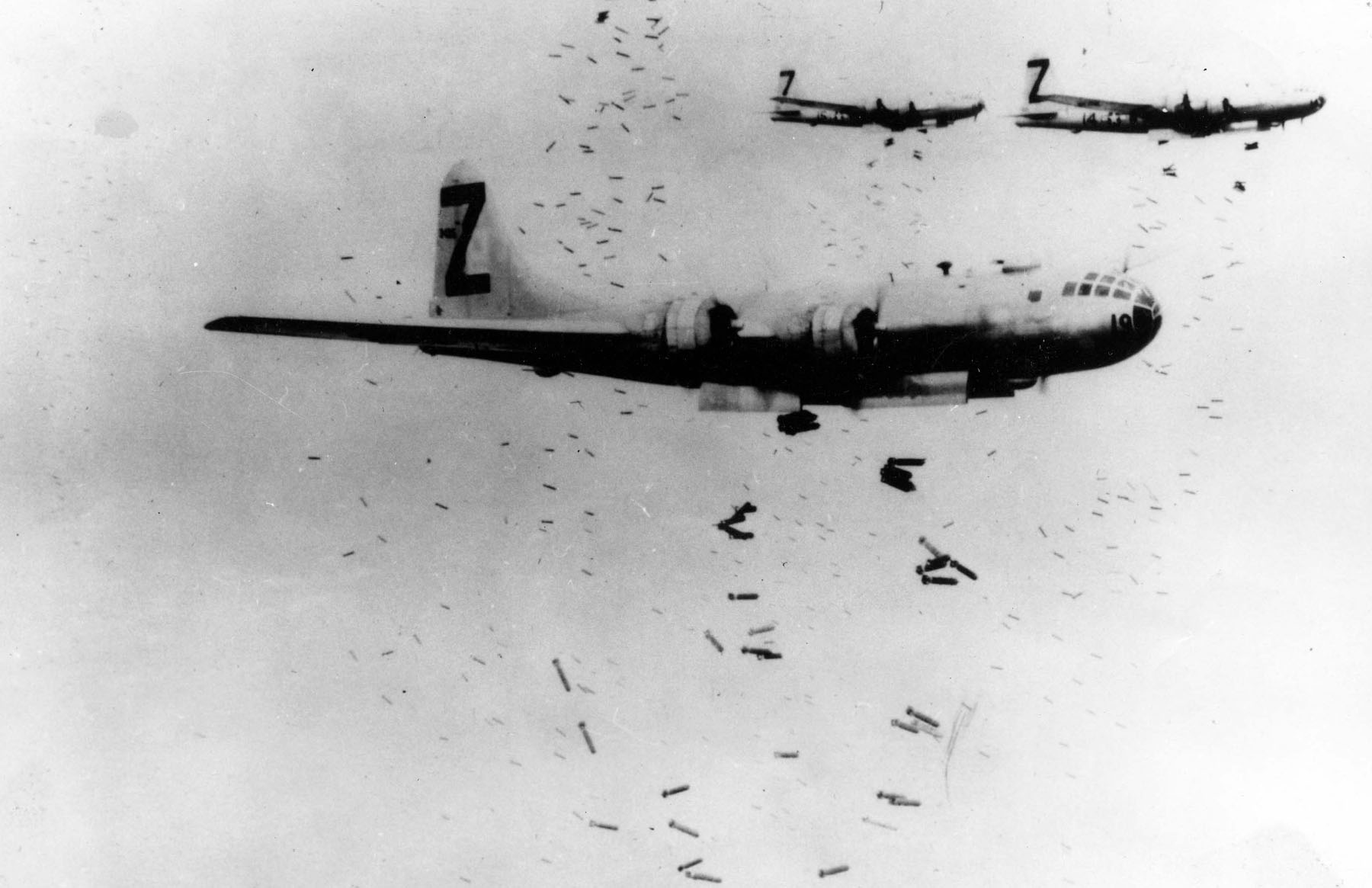


Incendiary Raid


Using M-69 napalm incendiary bombs over Tokyo on March 9, 1945 resulted in a greater number of deaths than the atomic explosion over Hiroshima five months later.  Wars create unintended consequences.  The rationale behind total war is that Hell on Earth now is meant to shorten the on-going nightmare... actually saving many lives.  Family loving people were required to make such decisions in World War II.
Picture:  1800 x 1165 at 300 dpi - Wikipedia       
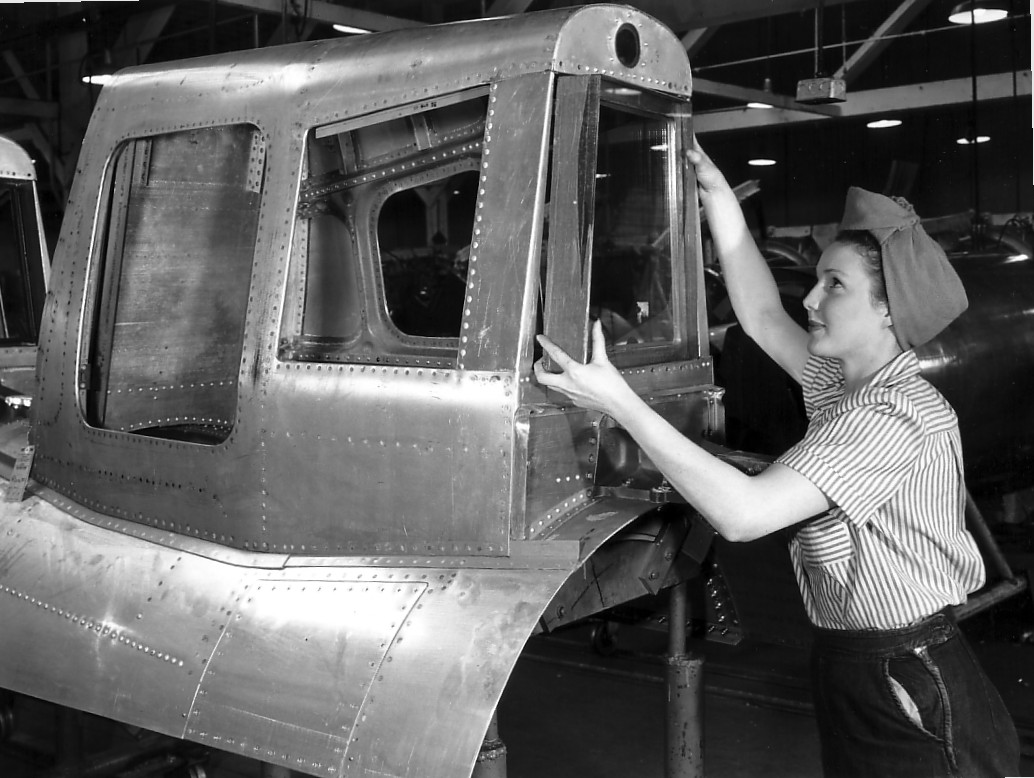


Assembly


At war's end more than 2,000 B-29s had been produced.  Immediately shutting down production would have put many people out of work so over a thousand additional aircraft were manufactured before work was halted in May, 1946.  Like a fast moving freight train the cost of war does not stop on a dime.  There is a momentum that will not be denied by the simple signing of a peace treaty.
Picture:  1034 x 778 at 100 dpi - Wreck Chasing


Projecting Power


Pressurized crew quarters, remote control gun turrets, and a rudimentary radar system used for ground targeting set the B-29 apart from other warbirds of its time.  But it was the concept of building an aircraft for the sole purpose of destroying strategic targets from high altitudes and thousands of miles away that would most influence aircraft design until missile technology came of age.  The weapons of mass destruction still exist but the fear of their use is nowhere near the level it was during the Cold War.  They will remain with us because, on a national level, goodwill comes up short of self interest.
Picture:  2792 x 2180 - World War II Database 

Related Topics:


W O R L D    W A R    I I    P L A N E S


Monday, December 19, 2011

B-47

B-47 Stratojet


Boeing


B-47 Stratojet


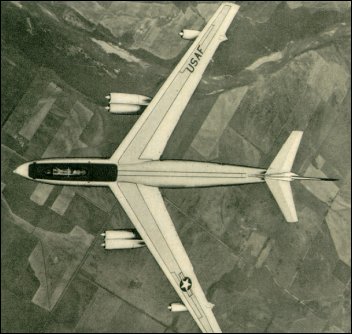
The B-47 was the first American all jet bomber.  German wartime research contributed to the swept wing design of both the F-86 Sabre and this medium range bomber.  It was truly a revolutionary aircraft when first flown in December, 1947 and its experience would heavily influence the design of the legendary B-52 introduced a few short years later.  


B - 47E


Crew:                    3 - Pilot, copilot, navigator-bombardier

Power:                  6 - General Electric 3269 kg / 7200 lb thrust J47-GE-25 turbojets

Max. Speed:         975 kph / 606 mph
Ceiling:                 12,352 m / 40,500 ft plus
Range:                  5794 km / 3600 miles
Climb:                  1326 m / 4350 ft per minute at maximum power

Weight -
Empty:                 36,663 kg / 80,756 lb
Max. Take Off:    89,973 kg / 198,180 lb

Size -
Wingspan:           35.36 m / 116 ft
Wing Area:         132.66 sq m / 1428 sq ft
Length:                33.48 m / 109 ft 10 in
Height:                8.51 m / 27 ft 11 in

Armament:
                          2 - 20 mm / 0.78 in cannon in remote controlled tail turret
                               9080 kg / 20,000 lb max. bomb load


V I D E O


B-47A


The B-47 had limited internal fuel capacity and was not a true intercontinental bomber without IFR (In Flight Refueling).  This capability was added to the B-47B model along with two 1500 gallon drop tanks attached to the wings.  Each wing of 45 bombers was expected to also have 20 KC-135 tankers to extend its range.  The KC-135s had incompatible piston engines making air refueling difficult for the born for speed Stratojet.  


1,500 B-47s deployed in 1956


The Strategic Air Command had 28 B-47 wings by the mid-1950s, not including the over 200 Stratojets used for reconnaissance missions.  The first B-52s began supplanting this force after 1955.  By 1960 the Air Force was phasing out the remaining B-47s with the new B-58 Hustler but numerous other factors including ICBMs and Polaris submarines made the medium range B-47 an expendable weapons system.  


Labeled Diagram


The 35 degree swept back wing was too thin to house landing gear which led to the bicycle arrangement along the center line of the fuselage.  Landings required concentration and could be particularly treacherous in a crosswind.  The B-47 was a demanding aircraft to fly and left pilots worn out after long flights.  


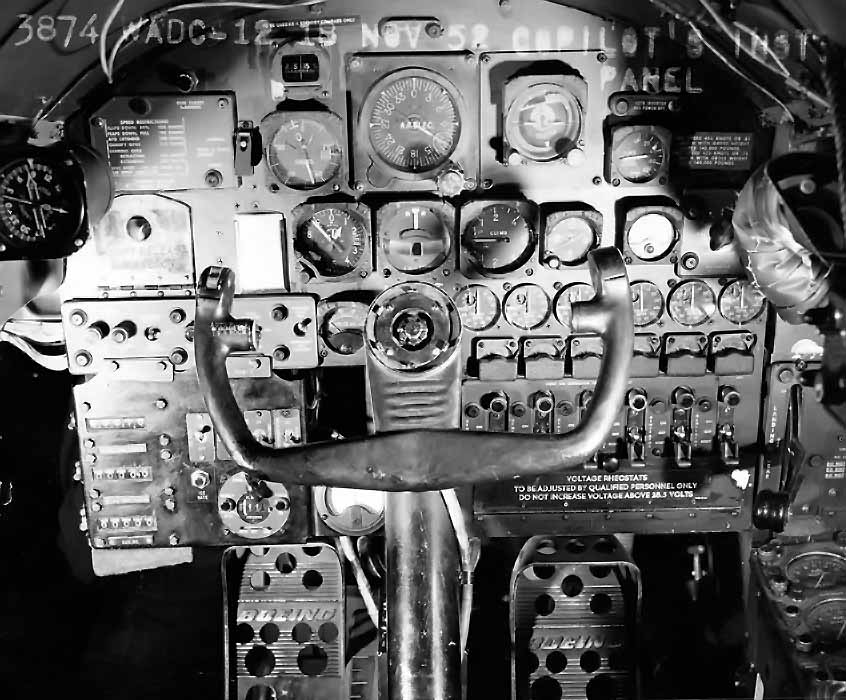
 Copilot Instrument Panel


The B-47 was a challenging plane to fly and tandem seating meant the two pilots could not see what the other was doing thus making crew coordination, rigorous checklist communication, all the more critical.  The large Plexiglas clamshell canopy provided an excellent view but made daylight flying extremely hot unless the navigator, buried in the nose, was left to freeze from air conditioning.  Little thought was given to crew comfort but as an aircraft it had the reputation for handling like a fighter. 


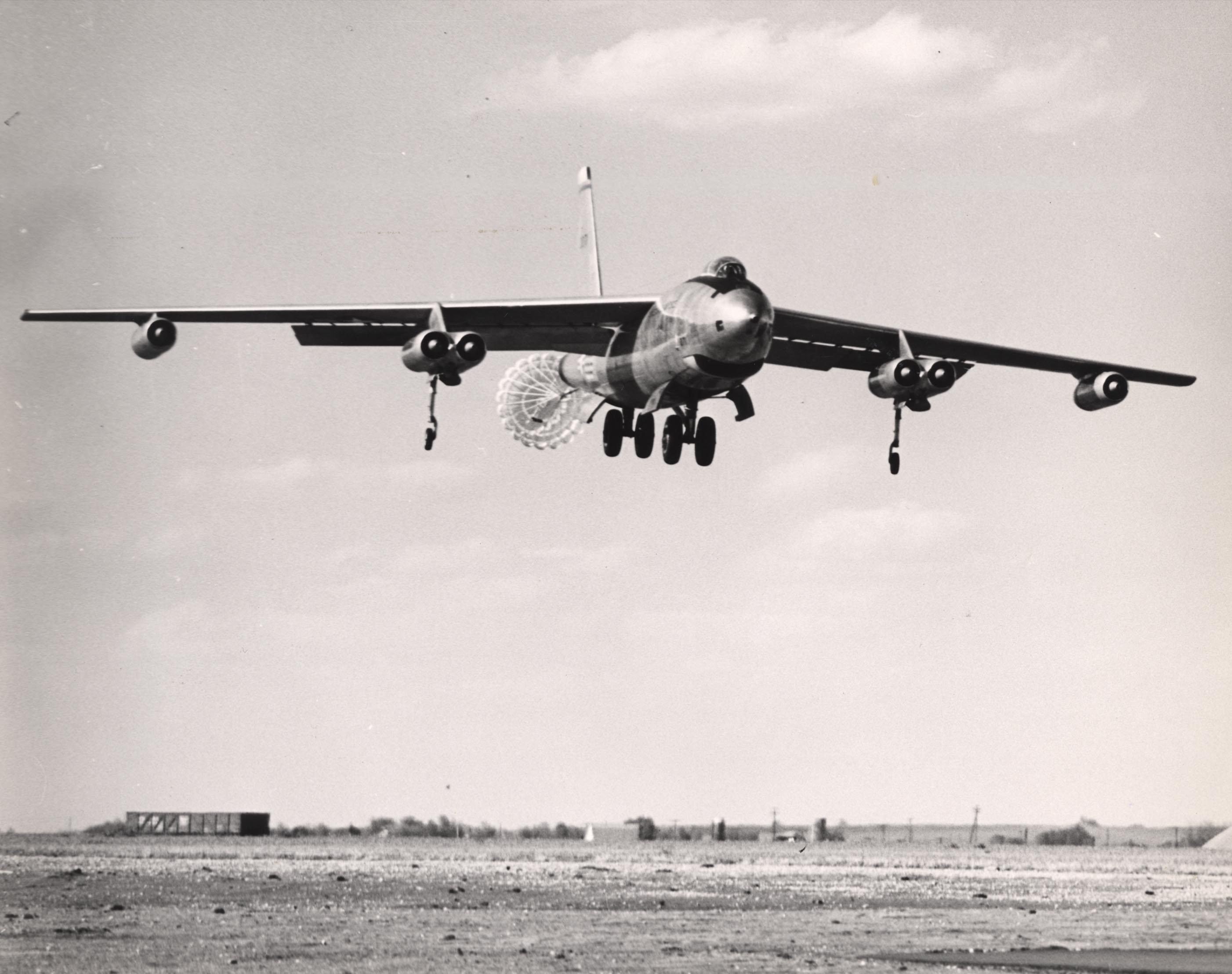
Tail Drag Chute


There were two chutes deployed on landing, an approach chute as seen above and a brake chute once landed.  This landing photo is from Lincoln Air Force Base Museum.


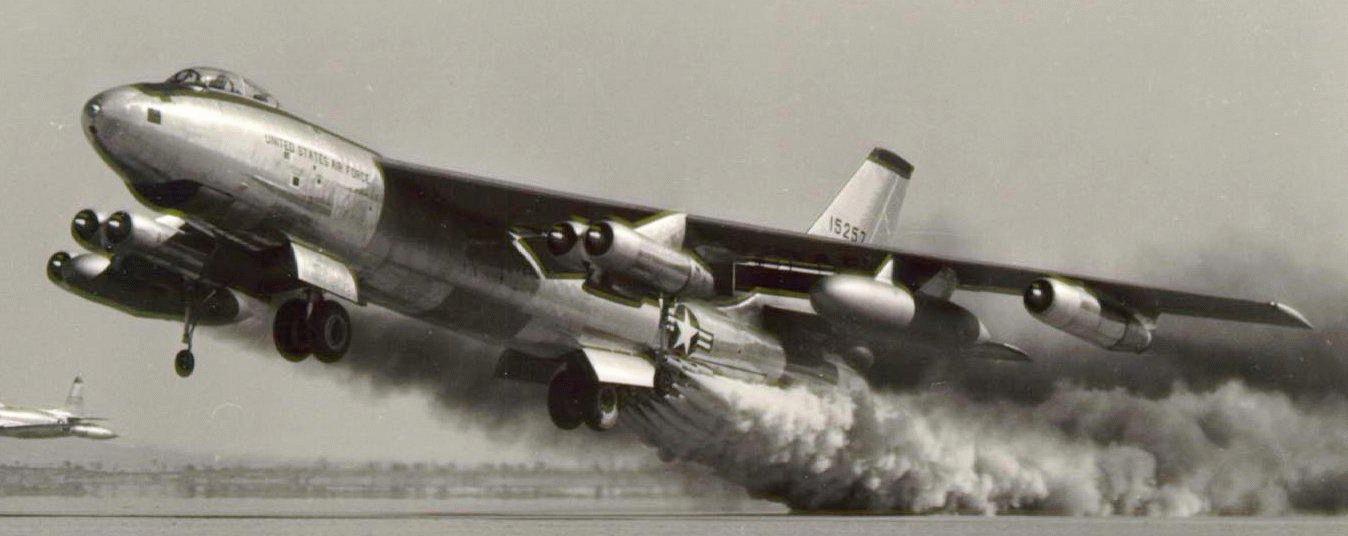
Rocket Assisted Take Off


Engines of the early jet age lacked power output and several were required.  Take offs with heavy payload were assisted by the additional boost of 18 solid fueled rockets located aft of the bomb bay.  Rocket assisted take off and parachute deceleration enabled B-47s to be more diversely stationed at air bases with shorter runways.  The image is at John Weeks.


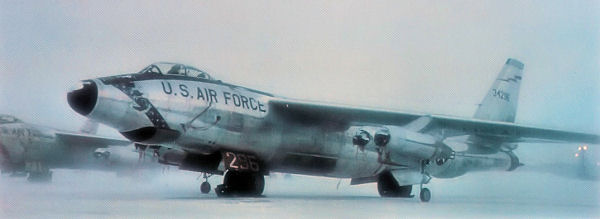
Eielson AFB, Alaska


Range was the primary limitation of the B-47 and many were based in England, Spain, North Africa and Alaska in order to be in striking distance of the Soviet Union.  


B-47 with claimed fighter performance


For the first couple of years following its introduction the B-47 could fly faster and higher than contemporary fighters.  It had an agility in handling unexpected for a bomber.  Its qualities made it the choice for highly dangerous reconnaissance missions into Soviet airspace prior to the U-2 during the early years of the Cold War.  


A V I A T I O N


OVER EASY


Sunday, December 11, 2011

B-52

B-52 Stratofortress


Boeing


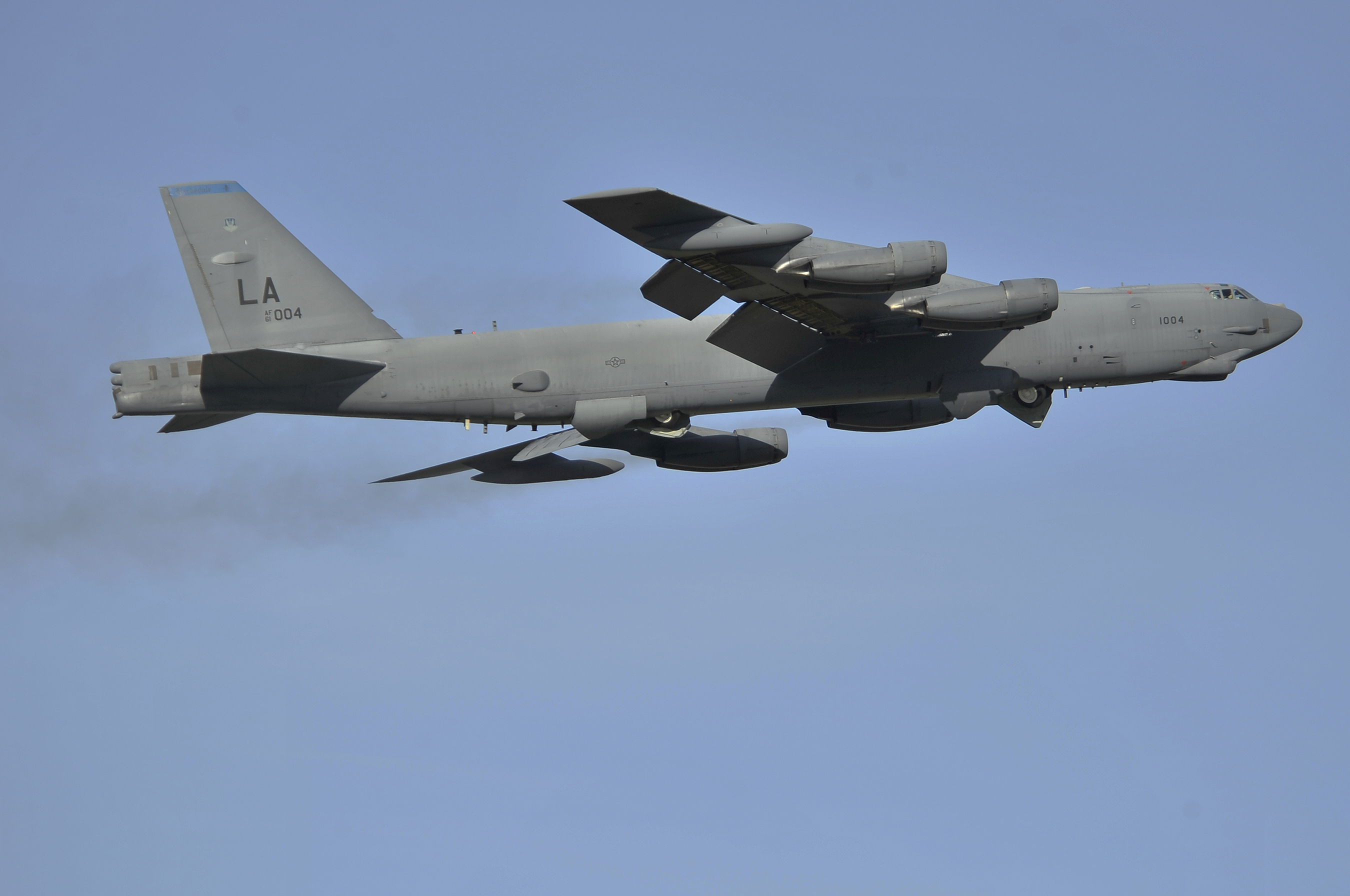
B-52H


Developed as a high altitude strategic bomber carrying a nuclear payload the B-52 has undergone considerable changes in its fifty year history reflecting changing technology and, most significant, the end of the Cold War.  


B-52D


Crew:                    6 - Pilot, co-Pilot
                                  2 - Bombing Navigation Systems Operators
                                  Tail Gunner (B-52H no longer has tail armament)
                                  ECM (Electronic Countermeasures) Operator

Power:                 8 - Pratt & Whitney 5493 kg / 12,100 lb thrust J57-P-19W turbojets
                                 (B-52H:  TF33-P-3 engines)

Max. Speed:        893 kph / 555 mph
Ceiling:                13,725 m / 45,000 ft
Range:                 11,861 km / 7370 miles
Climb:                  Not Available

Weight -
Empty:                85,806 kg / 189,000 lb
Max. Take Off:   204,300 kg / 450,000 lb

Size -
Wingspan:          56.4 m / 185 ft
Wing Area:        371.6 sq m / 4000 sq ft
Length:              47.7 m / 156 ft 6 in
Height:               12.75 m / 48 ft 3.7 in

Armament:
                        4 - 12.7 mm / 0.5 in machine-guns in tail (B-52H: none)
                        max. 108 conventional bombs up to 27,240 kg / 60,000 lb


V I D E O


B-52


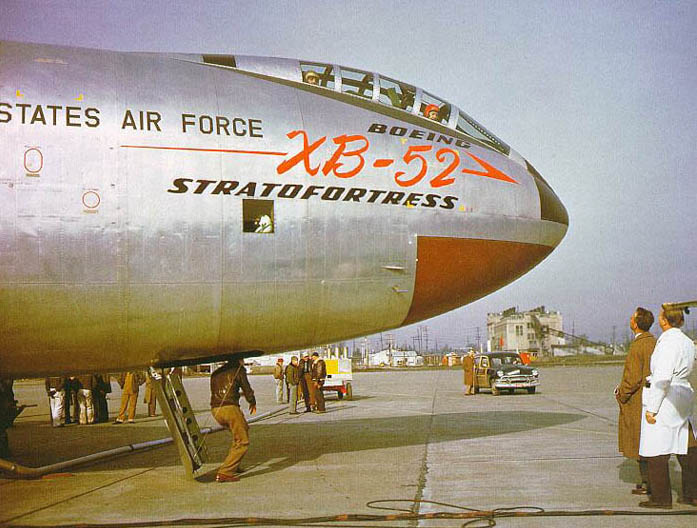
The original prototype B-52 that rolled out in 1952 had tandem seating for the pilot and co-pilot.  The arrangement was quickly changed to side-by-side with the B-52A.


Bomber Navigation Systems Operators


There remain 94 B-52H bombers in the USAF.  All other versions of the bomber have long been retired.  Their role since 1991 has been primarily conventional as opposed to providing nuclear deterrence.  The H model's range has increased to 15,300 km / 9,600 miles and its crews now train for low level night time approaches to their target as a counter to radar detection and the threat of surface-to-air missiles, SAMs.  


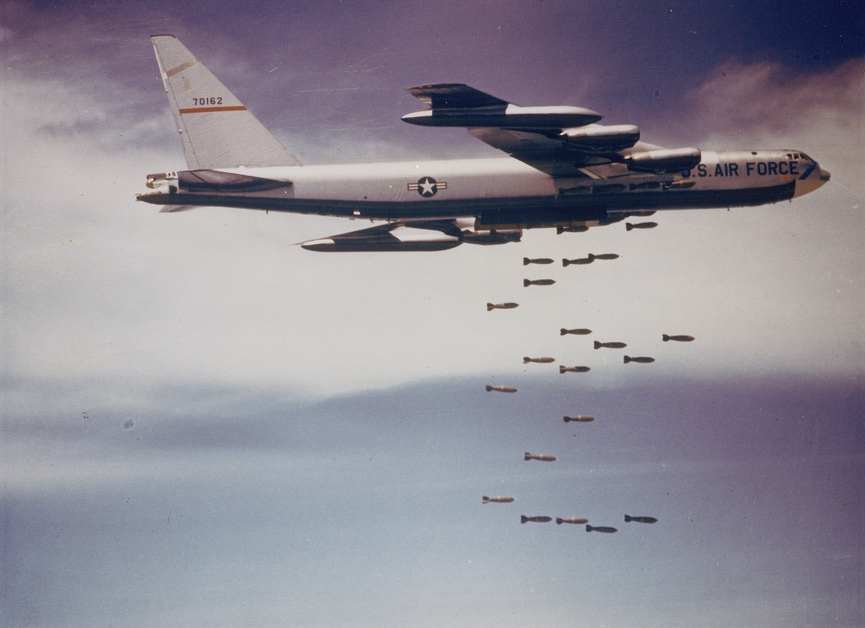
B-52D


Operation Arc Light was the use of B-52s over Vietnam.  The program began in June, 1965 and was initially limited to targets in South Vietnam.  By April of the following year B-52s began bombing targets in North Vietnam as part of Operation Rolling Thunder.  Eventually targets were clandestinely added in both Cambodia and Laos.  The effort culminated with the bombing of Hanoi in December, 1972.  The final B-52 sortie occurred January 28, 1973 - the day a cease fire with North Vietnam was signed.   


Low Level Bombing


Parachuting bombs enable the low to the deck attacking aircraft time to escape potential blast damage.  The flares are a countermeasure to ground fired heat seeking missiles.  The downing of an American U-2 over the Soviet Union by a SA-2 surface to air missile in May, 1960 spelled the end of the B-52 as an effective high-altitude strategic bomber.  The versatility of the B-52 as a weapons platform has enabled it to survive the end of the Cold War.  


Ordinance


There is nothing in the American arsenal that matches the capability of the B-52 to deliver 30 tons of conventional explosives to a target over 4,000 miles away.  This is the main reason why it is expected to remain in service for another couple of decades.  


Related Topics:

B-29 Superfortress

B-36 Peacemaker

Vulcan

Tu-95 Bear


A V I A T I O N


OVER EASY