Showing posts with label Kasserine. Show all posts

Tuesday, March 6, 2012

Sidi bou Zid

Battle of Kasserine Pass
14 February, 1943
Day 1


II Corps commander Major General Lloyd Fredendall placed an American infantry battalion on each of two mountaintops facing the German held pass of Faid.  The craggy slopes of Djebel Lessouda and Djebel Ksaira were defense enough against armored attack and Fredendall’s own armored combat group, CCA, located in nearby Sidi bou Zid, could counter any likely German offensive.  His best armored force, Combat Command B, CCB, was being held in reserve farther north near Fondouk, where an attack from 5th Panzer Army was predicted by a reputable intelligence source.  The mission for II Corps was clear – defend all positions currently held by the Americans then join with French and British forces in the spring in a drive to capture the Axis ports of Bizerte and Tunis, forcing the surrender of all remaining German and Italian troops in North Africa.


Map:  1265 x 966 -  Historical Resources

A line of more than a hundred tanks and another hundred plus trucks and halftracks loaded with panzer grenadiers trundled up Highway 13 toward Faid Pass in the predawn desert morning.  A cold blast of sand-filled air blinded the small squad of American infantry that faced toward Faid Pass and in the direction of the just now rising sun.  Their instructions were to radio a warning and to fire off a rocket at the first sign of any enemy advance.  The rocket’s arching star trail was a signal for American artillery to begin their deadly barrage on prearranged enemy held targets.  The sandstorm foiled this plan, muffling all sound of approaching panzers, enabling German troops to kill or capture every member of this forward outpost before they could raise the alarm.


Ten tanks from Company G, 1st Armored Regiment, had settled into their position just east of Djebel Lessouda when they came under intense panzer fire.  Their daily morning routine had been observed by the Germans over the previous week and the panzers of Kampfgruppe Gerhardt knew just where to find them.  They were destroyed quickly as were the six additional tanks that raced to their aid.  It was just after 0630 when the armored formations of the 10th Panzer Division poured freely from Faid Pass, sweeping aside the various, small American outposts as they went about their business of plucking the troops of Djebel Lessouda from the Allies’ grasp.   


Lt. Col. John Waters, commander of 2/168th Infantry, the battalion on this mountain bastion, received a phone call from CCA in Sidi bou Zid wanting a heads up on the firing coming from his area.  Waters was puzzled.  He had seen and heard nothing just moments before when he surveyed the surrounding desert floor from his command post lookout.  Of course, the steady sting of airborne grit and whistle of driving wind could easily mask most anything moving beneath the sandstorm shroud.  Now on his second look Waters detected faint flickers of light and the muffled thuds of what could only be the spoken anger of armor.  He quickly dispatched the 15 tanks assigned his battalion, ordering them to confront the enemy’s advance.  They would not be heard from again.  At 0650 Waters reports to CCA that his units are engaged with an enemy force of unknown size.     


Brig. Gen. Raymond McQuillin, Commander of CCA, was warned to anticipate a diversionary attack near his command post at Sidi bou Zid.  Allied command believed an attack in the area was intended to draw American forces away from the real target of German interest, the mountain pass near Fondouk.  McQuillin called on his armored reserve, ordering Lt. Col. Louis Hightower of the 3rd Battalion, 1st Armored Regiment, to proceed with his tanks towards Lessouda and to make things right.  As Hightower’s command of 36 new M4 Shermans burst into a sputtering volley of life, German Stukas appeared in a line overhead, tipping one by one into a steep dive, releasing their bombs, then laboring up and away from the waiting flat roofs of Sidi bou Zid.  Hightower’s men and machines roared off in the direction of the commotion,  an area known as the Oasis, the place where the ten tanks of Company G were last known to be. 


The combat formation of tanks and infantry known as Kampfgruppe Gerhardt had by 0800 swung their 30 tanks north, then cut west behind Djebel Lessouda, surprising and quickly overrunning a battery of artillery attached to Lt. Col. Waters’s battalion.  The men manning a detachment of large, World War I vintage howitzers near Sidi bou Zid met a similar fate as German troops methodically rolled up their confused American opponents.  By 0830 the sandstorm had lifted enough for Waters to discovered a large contingent of  panzers blocking his battalion’s route of escape on the road west towards Sbeitla.  Near the base of Lessouda Hightower’s Shermans were beginning to be picked off by the deadly 88mm fire of anti-tank weapons as well as the new, nearly invincible Panzer VI, or Tiger tank.  Hightower’s fortunes went from bad to disastrous as panzers converged on his force from two separate formations, Gerhardt and Kampfgruppe Reimann.  Hightower radios McQuillin a final time, saying he is badly outnumbered and can only try delaying the enemy’s advance.


Col. Thomas Drake received the Silver Star from Dwight Eisenhower, Supreme Commander, Allied Forces, at CCA headquarters the previous evening.  While there he expressed his concern to Gen. McQuillin about the placement of troops on Djebel Ksaira and Lessouda.  The two mountain redoubts were islands, easily isolated by any large armored force.  II Corps Commander Fredendall had personally positioned the units and no one dared seriously confront him with their objections.  It wasn’t normal U.S. Army protocol but Fredendall ran the 1st Armored Division, leaving its commander, Maj. Gen. Orlando Ward, little to do but pass along Fredendall’s orders.  Now Drake watched through field glasses the dismantling of Hightower’s counterattack and the encirclement of Waters’s 2nd Battalion.  He reports sighting over eighty panzers and a crumbling American position by phone to McQuillin.  McQuillin has news for Drake, as well.  Reconnaissance near Maizila Pass reports a large formation of panzers heading Drake’s way from the south.  That’s OK.  That’s what Drake’s 3rd Battalion was in position for – defend against an attack from the south. 


The problem is this isn’t any local diversionary attack.  With German’s sweeping around Waters to his north and now a panzer formation heading toward him from the opposite direction it’s looking more like the entire CCA combat group is in danger of being swallowed up in a large double envelopment.  This situation calls for the cavalry riding to the rescue – a large mobile armored reserve moving in to counter the German thrust.  All there is, though, is Hightower’s battalion of Shermans.  This is why Eisenhower wanted 1st Armored Division kept together instead of being scattered piecemeal up and down the line of defense extending along the Eastern Dorsal mountain range.  Instead, 1st Armored is a shell, a headquarters with no one to command except for some foot soldiers waiting at Sbeitla.    


McQuillin sums it up – Waters’s 2nd Battalion is cut off at Lessouda, panzers are headed towards Drake’s 3rd Battalion from the south and his only reserve, Hightower’s M4 Shermans, are involved in a firefight with a much larger force.  McQuillin doesn’t need the map to know the road to Sbeitla, headquarters for 1st Armored Division, is wide open and unguarded.  McQuillin provides Ward, Division Commander, an update of the situation.  Ward, while still viewing the day’s events as a local action, agrees the road to Sbeitla needs defending.  He orders Lt. Col. William Kern’s infantry battalion eleven miles east, setting up a blocking position where highways 13 and 3 intersect.  As the day progressed, this line of 3rd Battalion, 6th Armored Infantry Regiment, would become a rallying point and be referred to as Kern’s Crossing.


At 1030 hours four American planes make a brief appearance overhead and quickly leave.  Despite repeated pleas that cameo appearance would be the extent of friendly air support for embattled American troops.  Meanwhile they will be harassed throughout the day by Luftwaffe strafing and dive bombing attacks.  On Djebel Lessouda Waters’s battalion is surrounded, but ignored, as 10th Panzer tanks are busy picking off Hightower’s Shermans as his dwindling force is pushed back towards Sidi bou Zid.     


McQuillin updates Ward at 1130 hours.  Enemy tanks are closing in on his CCA command post while Drake’s 3rd battalion is in danger of being cut off at Djebel Ksaira.  Kampfgruppe Schutte, the first combat group to arrive from Maizila Pass, is making its presence known.  It’s just about now that General Eisenhower leaves Fredendall’s II Corps headquarters having completed his review of the troops.  His understanding is that a local action is taking place near Sidi bou Zid and the situation is under control.  That’s the problem with Fredendall’s command post being isolated in a remote ravine nearly fifty miles from the front line.  Maj. Gen. Fredendall has no comprehension of the battle being waged and he will compound this problem throughout the day by making the battlefield decisions that would best be left with the commanders on the scene.


Map:  1265 x 966 - Historical Resources

As the noon hour approaches Sidi bou Zid is under direct tank fire and Gen. McQuillin and his CCA staff flee to a spot west of town and set up a new temporary command post.  By now Hightower has lost over half his tanks.  He has managed to take out four panzers with his own tank, named Texas, before it too, is hit and catches fire.  Hightower and his crew scramble free and begin a long hike in the direction of Sbeitla.  Only seven of the tanks from his battalion will survive the day.   Ten miles to the southeast Col. Drake is consolidating his defense around Djebel Ksaira and another up cropping named Garet Hadid.  There is no defense from panzers for his infantry except for these rugged, isolated heights.  Still, this is a desert and they can’t stay there forever. 


By 1240 McQuillin has lost all communication with his unit commanders, Waters, Drake and Hightower.  He gets off a quick message informing Ward at Division before shelling forces him to, once again, pull up stakes and move his command post.  Without communication and proper coordination some units begin retreating across open terrain and become easy targets for prowling Stukas overhead. 


By 1400 the second punch from Maizila Pass arrives near Sidi bou Zid.  Six massive Tiger tanks bull their way through the town while Kampfgruppe Stenkhoff maneuvers to trap Combat Command A, sealing off all escape routes to Sbeitla and points west.  McQuillin sets up a new command post five miles outside Sidi bou Zid and Col. Drake reestablishes communication with him, requesting a withdrawal of his forces from Djebel Ksaira.  McQuillin understands the need to pull back 3rd Battalion before they are totally cut off, but he hasn’t the authority to make the call.  He contacts Maj. Gen. Ward at 1st Armored Division.  It’s out of my hands, Ward says.  He kicks the request upstairs to II Corps Commander Fredendall.  From his perspective Fredendall presumably believes he needs to provide the steady hand to calm excitable troops, inexperienced in the ways of combat.  II Corps’ response backtracks through Ward then to McQuillin and finally crackles over the receiver into Col. Drake’s ear:  “Hold your position” – request denied.


At 1600 hours the fortunes of war are such that Lt. Col. Waters finds himself separated from his command on Djebel Lessouda.  The footsteps near by he believes are those of his men and he rises from a ravine.  He has come face to face with seven German soldiers and two Arab guides.  The war for Waters is over.  He is taken into captivity.  It won’t be too much later that the German’s discover they hold the son-in-law of Gen. George Patton.   By 1700 hours McQuillin has once again moved his command post, this time a bit east of Sbeitla.  Near Sidi bou Zid tanks from 10th Panzer meet up with tanks from 21st Panzer Division, the force that drove north from Maizila Pass.  The double envelopment of CCA took just twelve hours and cost 5th Panzer Army surprisingly few casualties.  The nearby landscape is littered with wrecked and abandoned American equipment – 44 tanks, 59 halftracks, 26 pieces of artillery and 22 trucks. 


Gen. Heinz Ziegler, deputy to 5th Panzer Army Commander Hans-Jurgen von Arnim, surveys the scene and renders his judgment.  They have done well.  It is time to consolidate their forces and prepare for tomorrow’s anticipated counterattack by the Americans.  Tomorrow will also see Field Marshal Erwin Rommel’s famed Afrika Korps come onto the scene.  Rommel has big plans for the Americans – something more than the bloodied nose they suffered today.  He insists Ziegler not stop now but push on into Sbeitla and rout the Americans while they are still off balance.  Teach them they are unworthy as soldiers to fight the German Wehrmacht.  Teach them now, while they are still green and very much impressionable.  But Ziegler answers to von Arnim and the 5th Panzer Commander believes Rommel a bit reckless.  The troops stay where they are.  Arnim has plans and they don’t jell with Rommel’s.  The engagement that becomes the Battle of Kasserine Pass begins with a divided command.  The competition between Rommel and von Arnim may be the biggest factor that ultimately saves the Americans at Kasserine.


Friday, March 2, 2012

Rendezvous of Generals

Rendezvous of Generals
13 February, 1943
C L I C K     T O     E N L A R G E

Picture:  401 x 368 - Argentina Salvajizada

Dwight Eisenhower, Supreme Commander of the allied forces, North Africa had just received his fourth star.  It gave him the appropriate rank to oversee his British deputies that ran the day to day business of war.  During the night of February 12th he slipped away from his headquarters in Algiers and drove in a small convoy of vehicles toward Tebessa, the major supply and command center for II Corps, headquarters for the American troops in Tunisia.  Eisenhower’s visit was prompted by a number of concerns, most recent being the increased activity of Colonel General Hans-Jurgen von Arnim’s 5th Panzer Army.  On January 30th, elements of the 21st Panzer Division overwhelmed poorly equipped French troops and captured Faid Pass, breaching the Allied line of defense along a mountain range called the Eastern Dorsal.  Now there were highly regarded intelligence reports of a new planned German attack at another pass farther north near a town called Fondouk. 


Picture:  747 x 425 at 96 dpi - Wikipedia

Lieutenant General Kenneth Anderson, commander of the allied 1st Army in Tunisia, was holding powerful elements of the American 1st Armored Division and Major General Terry Allen’s 1st Infantry Division, The Big Red One, in reserve near Fondouk.  Anderson need not know the source of his intelligence, Ultra, was a super secret organization located at Bletchley Park near London, that had cracked the German military’s Enigma code.  What Anderson did know was that his intelligence source had been of immense aid to General Bernard Montgomery in defeating Erwin Rommel at El Alamein.  With the aid of Ultra, Montgomery knew the strength of the German Afrika Korps and could anticipate Rommel’s every move.  Now this same source encouraged Anderson to focus his strength away from American positions that were thinly dispersed along a line that led further south. 


Picture:  904 x 587 - BT Yahoo

Field Marshal Erwin Rommel had led his Afrika Korps in a demoralizing retreat for almost three months since his loss at El Alamein in early November the previous year.  In the course of his westward trek across Libya he had infuriated Mussolini by ceding to the British Eighth Army the important port of Tripoli without even a respectful semblance of battle.  He had alienated his benefactor, Hitler, by displaying what the Fuhrer perceived to be both a loss of nerve and an attitude of defeatism.  Now, as his troops began assembling along the Mareth Line, a series of fortifications in eastern Tunisia that were built by the French, Rommel turned his eyes towards a target he believed to be ripe for plunder.  The newly arrived American troops, barely trained and mostly untested in battle, appeared vulnerable to Rommel’s famed tactic of a focused, crushing armored attack.  His infantry at Mareth would be an adequate defense while Montgomery took the next few weeks organizing his Eighth Army for a new offensive push into Tunisia.  Meanwhile, Rommel could use this time to scatter the American forces, capture Tebessa and, who knows, send the allied forces reeling into western Algeria.  It seemed a feasible plan but, with the depleted state of Rommel’s Afrika Korps, he would need cooperation and help from the other German force occupying Tunisia, Arnim’s Fifth Panzer Army.


Picture:  800 x 602 at 96 dpi - WW2 Total

Operation Torch, the allied invasion of North Africa, forced Hitler to protect the important Tunisian ports of Bizerte and Tunis with troops and tanks he would have preferred sending to the Russian Front.  The commander of the newly constituted Fifth Panzer Army, Colonel General von Arnim, believed the available resources limited his role to a defense of small attacks designed to keep the allies off balance.  For Arnim there simply wasn’t the supplies available to fuel the sustained offense proposed by Rommel.  The immediate superior to both generals, Field Marshal Albrecht Kesselring, sided with Rommel and obtained from Arnim an agreement of grudging support.  The coming campaign would prove Arnim’s support was always too late with too little.


Picture:  1265 x 966 - Historical Resources

Eisenhower met with his commanders in the field through Saturday and into the early morning hours of Sunday, February 14th, 1943 – Valentine’s Day.  He found his admonition to keep the 1st Armored Division together as a potent reserve force had gone unheeded.  There simply were too many holes to be filled over the long front and too few infantry units available to honor Eisenhower’s instructions.  The allied Supreme Commander was visibly disturbed by the complacency exhibited among the green American troops and their officers.  Their ideas of combat were fantasy.  Their training left them unprepared for the storm that would descend upon them with the rise of that Sunday morning’s sun.  The experience of the next several days would give its survivors an appreciation of the difference between a sleepy field manual exercise and the sharp focus that life versus death gives to what you've learned and what you do.

Tuesday, February 7, 2012

Rommel's Kasserine Command

Kasserine Pass
1943
C L I C K     T O     E N L A R G E


As the famous Afrika Korps backtracked across Libya during January, 1943, its commander, General Erwin Rommel, was persona non grata with those that mattered most, Hitler and Benito Mussolini.  Rommel had become increasingly disillusioned by the lack of support given his North African troops.  Hitler was absorbed with the deteriorating situation on the Eastern Front in Russia.  His once powerful Sixth Army was days away from being completely eliminated at Stalingrad while his remaining troops and armor in southern Russia were in a desperate fighting retreat trying to stay clear of the closing Russian noose.  For Hitler everything depended upon staunching the German bleeding on convulsive Russian steppes.  What could Rommel possibly expect?  Hitler had no real ambition in North Africa.  His valuable panzer armor was stuck in this bleak desert owing to the inept military performance of his Italian ally.  Rommel’s charge was to hold off British advances.  There never really were the resources available for Rommel to gain a decisive German victory.  Yet despite being outmanned and outgunned Rommel fought only to win.  He was too brilliant a battlefield tactician to ever play for the draw. 
Picture:  1480 x 1035 at 96 dpi - Reddit


Even as Rommel stayed one step ahead of General Bernard Montgomery’s pursuing Eighth Army a new threat was now looming to his west.  A large combined British and American force had landed on the North African shores near his source of supply in Tunisia.  Rommel now faces almost certain failure for the German military adventure in North Africa, even with the recent arrival of the Fifth Panzer Army in Tunis.  How ironic it was.  The reinforcements Rommel had long clamored for arriving now - too late to clench victory, too late to defy collapse.  Hitler hears his once favorite General calling on the proud Wehrmacht to abandon its equipment and board the men on anything that flies or floats, returning them to Europe Dunkirk style.  For both Hitler and Mussolini this is worse than heresy.  This is defeatism.  Dictators are not immune to the political heat that comes with the momentum of defeat.  Once loyal allies begin to waver, looking for an exit.  One’s own population becomes demoralized, sullen.  You are no longer viewed with the confidence given the captain of a winning team.  You begin to sense treachery in the acts of those about you, those you need to trust.  Rommel thought he could reason with men who clung to their needed delusions.  His call for desperate measures placed new weight on Hitler's already buckling view of empire.     
Picture:  300 x 250 - Famous People
Faced with diminished confidence in his leadership Rommel was no longer master of all that was German in North Africa.  He now shared authority equally with the commander of the Fifth Panzer Army, General Jurgin von Arnim.  His plans required authorization from the Italian Comando Supremo in Rome.  He found himself battling a divided command and impatiently awaiting approval of plans in a time requiring quick and decisive action.  These were the dynamics within the Axis leadership that would be responsible for the incomplete victory of the Afrika Korps in the upcoming Battle at Kasserine Pass.  Opportunities to turn battlefield wins into crushing victories would be missed because of competing lines of authority and bureaucratic delay.  Bold strategic thrusts that would unravel the Allied command in Tunisia would be hedged and muddled by uncomprehending officials hundreds of miles and a world apart from the ever changing battlefield action.  No one more than Rommel could better appreciate the hollow nature of this win when compared with what truly might have been.    
Picture:  800 x 606 - Tank Front               

Prelude To Kasserine

North Africa
1943
C L I C K     T O     E N L A R G E


War is too important to be left to generals, French Prime Minister Clemenceau is famously reported to have said near the end of World War I.  Decision making in war sometimes defies military logic.  
Picture:  300 x 300 - Quote Bunny


Hitler saw no military reason for sending his precious panzer divisions to North Africa while he was embroiled in a life or death struggle with hundreds of Soviet divisions on the Eastern Front.  The Deutsches Afrika Korps existed out of political need to protect Mussolini.  Were Italy to lose her African colonies to the Allies, Mussolini’s hold on power would become tenuous and Italy in danger of switching sides in the war. 
Picture:  1199 x 1600 - History Martinez


Hitler’s brilliant battlefield tactician, General Erwin Rommel, defied orders limiting his offensive actions to Libya and drove his forces deep into Egypt, confronting Britain’s Eighth Army at a place called El Alamein.  Rommel’s thirst for decisive victory put his troops in a near impossible situation by ignoring his own logistical limitations.  He had stretched his supply lines from ports in Italy to their farthest possible reach of two thousand miles.  The best his army could hope for was provisions sufficient to sustain a defensive posture only.  Rommel’s talent for highly mobile armored maneuvering required fuel that just wasn’t available.  
Picture:  303 x 382 - Lindsey Williams


His only hope for salvation would be an uncharacteristic offensive blunder by the ever meticulous and cautious General Bernard Montgomery, leader of the British Eighth Army.
Picture:  585 x 350 - Tiny Pic


It wasn’t to be, and Rommel’s Afrika Korps began a long retreat in November, 1942 with British forces doggedly pursuing them across the length of Libya and into Tunisia where the Panzerarmee would attempt to bolt shut the door at a French built fortification known as the Mareth Line.
Picture:  460 x 276 - Reddit


General Dwight Eisenhower commanded a combined army of British, French and American forces stretched thinly over 250 miles of hills and mountain ridges that bordered the Axis held coastal regions of Tunisia.  Eisenhower is content to maintain a defensive posture while his forces build in strength, preparing a thrust to the coast later in the spring that intends to first divide, then overwhelm opposing German and Italian troops.
Picture:  250 x 317 - Reddit


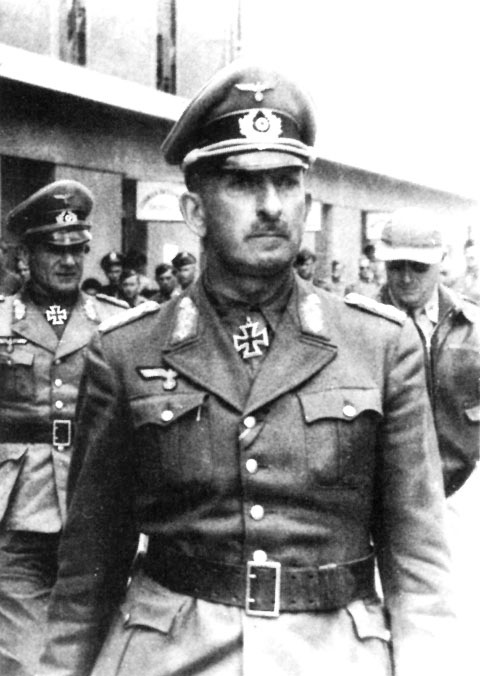
General Jurgin von Arnim is fully aware he cannot hope to match the Allies’ build up of men and material as the German Wehrmacht has been depleted of resources by setbacks in Russia, including the impending destruction of the Sixth Army at Stalingrad.  Through much of January, 1943 Arnim’s Fifth Panzer Army has been methodically eroding Eisenhower’s strength with short, quick jabs at vulnerable positions, particularly among the poorly equipped French troops.  Now, on January 30, a more ominous breach of the Allied line has occurred at a French held mountain pass named Faid.  Allied leaders believe it is a diversion.  They expect von Arnim to attack further north near Fondouk and threaten the British First Army by breaking into their rear.
Picture:  480 x 676 at 300 dpi - Worth Point


The Allies move their few armored reserves into the area and their miscalculation would shortly open the door for a dangerous penetration by General Erwin Rommel’s veteran panzers.  The action delivers a stunning defeat to inexperienced, poorly trained American troops and briefly threatens to hurl the Allies back into Algeria, setting back their chance for victory in North Africa.
Picture:  800 x 503 at 300 dpi - Reddit